Introduction
Cryptocurrency cold storage is a method of protecting private keys by keeping them in an offline or isolated environment.
The cryptocurrency itself does not sit inside a physical wallet. The blockchain records the associated accounts and balances. A wallet provides the tools needed to manage the cryptographic keys that authorize transactions. Ethereum.org, for example, distinguishes an account from the wallet interface used to interact with it.
Cold storage can reduce exposure to online threats, but it does not eliminate every risk. Physical loss, fraudulent transactions, compromised backups, malicious software, and setup errors can still result in lost access.
This guide explains how cold storage works, the forms it can take, and the security trade-offs involved.
Key Takeaways
- Cryptocurrency cold storage keeps private keys in an offline or isolated environment to reduce their exposure to internet-based attacks.
- A cold wallet is a tool used within a cold-storage system. Cold storage refers to the broader security arrangement.
- Hardware wallets may connect to an online computer or phone while keeping private keys isolated inside the signing device.
- Recovery phrases require the same level of protection as the wallet because they may recreate the wallet’s private keys.
- Metal recovery backups protect recovery information from physical damage, but they are not complete wallets by themselves.
- Paper wallets are a legacy method that can introduce significant generation, printing, backup, and transaction-handling risks.
- Cold storage reduces certain online risks but cannot prevent phishing, fraudulent transaction approvals, physical theft, or human error.
- No storage method is universally safest. Security depends on implementation, backup management, transaction verification, and the user’s threat model.
Educational notice: This article provides general information about cryptocurrency wallet security. It does not provide investment, financial, legal, tax, or individualized cybersecurity advice. Wallet procedures differ by asset, network, and provider. Consult the official documentation for the wallet and network you use before handling private keys, recovery phrases, or transactions.
Affiliate disclosure: Some links on this website may be affiliate links. The publisher may receive compensation when a reader makes a purchase through one of those links. Affiliate relationships do not change the editorial standards applied to this article.
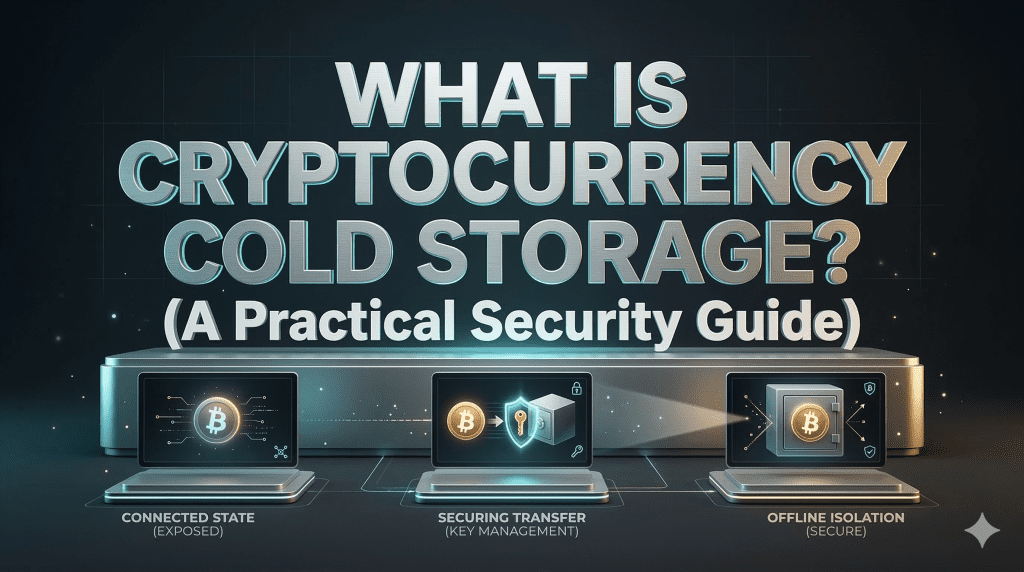
What Is Cryptocurrency Cold Storage?
Cryptocurrency cold storage is an arrangement in which private keys are generated, stored, or used in an environment designed to remain offline or isolated from networked systems.
A private key is secret cryptographic information that allows a person or system to authorize transactions. Anyone who obtains it may be able to control the associated account.
Cold storage focuses on limiting the private key’s exposure to:
- Internet-connected computers
- Browser extensions
- Mobile applications
- Cloud services
- Remote attackers
- Malware on general-purpose devices
This reflects a broader principle of cryptographic key management. The National Institute of Standards and Technology’s key-management guidance treats generation, storage, use, protection, backup, and destruction as parts of the same key-management lifecycle. Protecting a key in one location does not make the entire system secure if another part of that lifecycle is weak.
Cold storage should therefore be understood as a system, not merely as a device placed in a drawer.
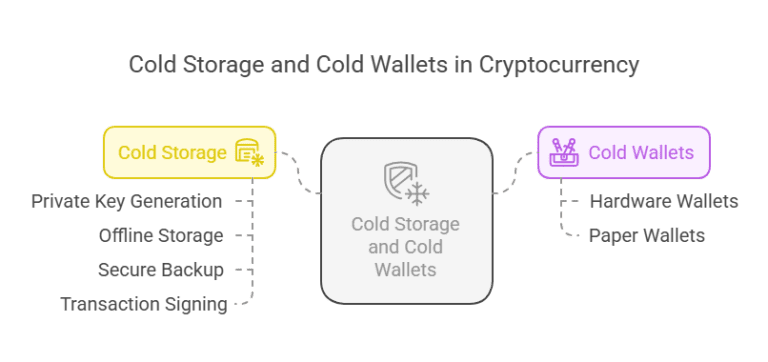
Cold Storage vs. Cold Wallet
The terms cold storage and cold wallet are often used interchangeably, but they describe different concepts.
Cold Storage
Cold storage is the broader security method.
It includes the procedures, devices, backups, access controls, and physical protections used to keep private keys away from online environments.
A cold-storage arrangement might include:
- A hardware signing device
- An offline computer
- A recovery-phrase backup
- Secure physical storage
- A documented recovery process
- A separate online watch-only wallet
Cold Wallet
A cold wallet is a wallet or signing tool used as part of that arrangement.
For example, a hardware wallet may hold or derive private keys and sign transactions without transferring those keys to the connected computer.
The distinction can be summarized simply:
A cold wallet is one component of that strategy.
Cold storage is the security strategy.
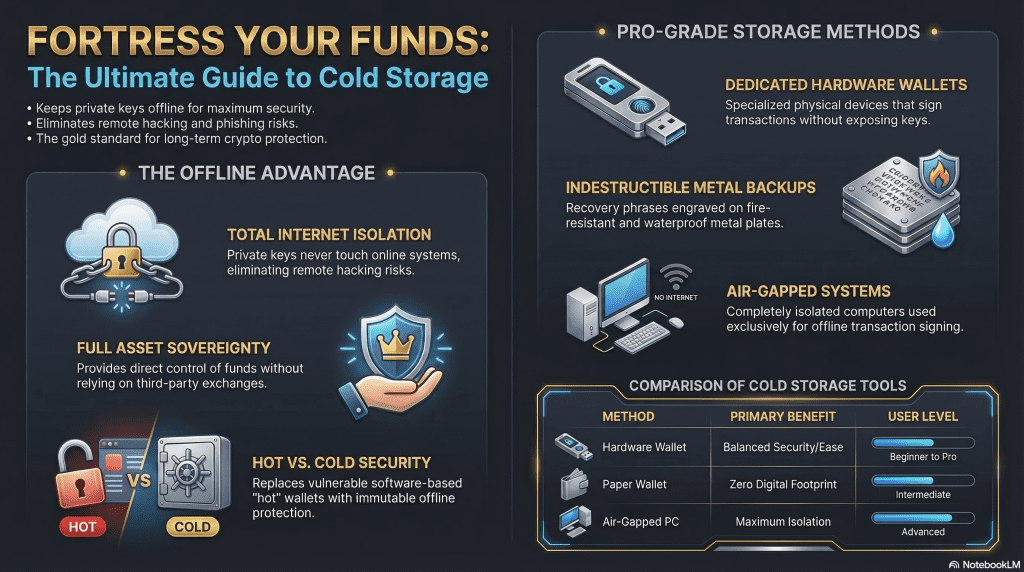
How Cold Storage Works
Cold-storage workflows differ by wallet and blockchain, but most involve four basic functions.
1. Key Generation
The wallet creates cryptographic key material.
Many modern wallets also generate a recovery phrase. BIP 39, one widely implemented standard, describes how computer-generated randomness can be represented as a human-readable mnemonic sentence and converted into a wallet seed. Standard BIP 39 phrase lengths include 12, 15, 18, 21, and 24 words.
A recovery phrase is not a normal password. Depending on the wallet, it may allow someone to reconstruct the keys controlling multiple accounts.
Ethereum.org describes the recovery phrase as the wallet’s master key and warns that anyone who obtains it may gain access to the associated accounts.
2. Offline or Isolated Key Storage
The private key remains inside an offline computer, dedicated signing device, or other isolated environment.
The device itself does not always need to remain physically disconnected.
A hardware wallet, for example, can communicate with an online computer while keeping the private key inside the hardware device. The computer sends transaction information to the device, and the device returns a digital signature.
The Bitcoin developer guide describes hardware wallets as signing-only devices that can communicate with networked systems without transferring the private keys to those systems.
3. Transaction Signing
A transaction must be digitally signed before it can be submitted to the network.
In a traditional offline-signing arrangement:
- An unsigned transaction is created on an online device.
- The transaction is transferred to the offline signer.
- The transaction details are reviewed.
- The offline device signs the transaction.
- The signed transaction returns to the online device.
- The online device broadcasts it to the network.
This separation allows the online system to prepare and broadcast transactions without possessing the private key.
4. Recovery and Backup
Cold-storage systems normally require a recovery method in case the original device is lost, damaged, reset, or becomes unusable.
The backup may be:
- A recovery phrase
- An encrypted wallet file
- A set of key shares
- A provider-specific recovery method
- An institutional backup process
The correct backup procedure depends on the wallet. A backup created for one system may not work as expected with another.
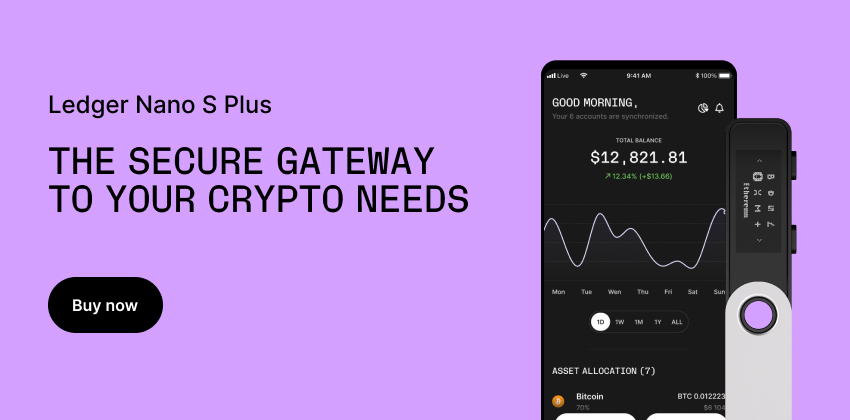
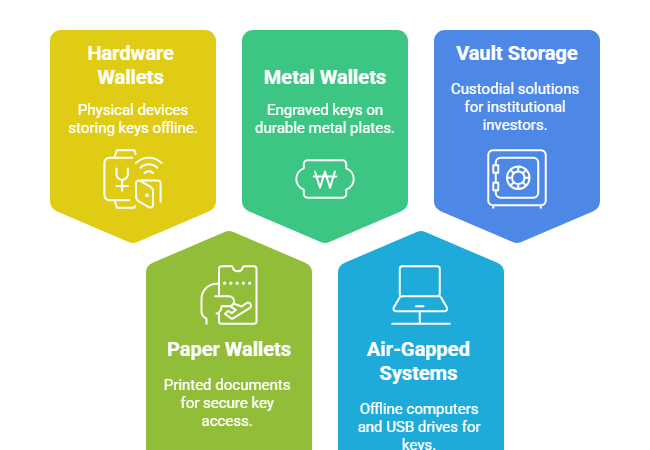
Types of Cryptocurrency Cold Storage
Different cold-storage methods isolate keys in different ways. They should not be treated as equivalent.
Hardware Wallets
A hardware wallet is a dedicated device that generates, stores, or uses private keys for transaction signing.
It may connect to a phone or computer through USB, Bluetooth, near-field communication, a memory card, or QR codes. The connection method alone does not determine whether the private key remains isolated.
A typical hardware-wallet transaction works as follows:
- Wallet software prepares the transaction.
- The hardware device receives the transaction details.
- The user reviews those details on the device.
- The device signs the transaction internally.
- The signed transaction returns to the online software.
Hardware wallets reduce the need to place private keys on a general-purpose computer. They still depend on secure setup, authentic hardware, trusted firmware, correct transaction review, and protected recovery information.
Air-Gapped Signing Devices
An air-gapped signer operates without a direct network connection.
Transaction information may move between the signer and an online device through:
- QR codes
- Memory cards
- Removable drives
- Other controlled transfer methods
Air-gapping reduces direct network exposure. It does not automatically make a system secure.
Removable media, malicious transaction files, compromised software, unsafe key generation, and incorrect transaction review can still create risk.
The Bitcoin developer documentation notes that offline wallets reduce attack vectors but require users to transfer data and review outgoing transaction details before signing.
Offline Computers
A dedicated offline computer can run wallet software and sign transactions without connecting directly to a network.
This approach can provide strong isolation, but it also increases operational complexity. The user must consider:
- How the operating system was installed
- Whether network interfaces are disabled
- How software updates are verified
- How transaction files enter and leave the device
- Whether removable media could introduce malware
- How the device and its backups are physically protected
An offline computer is not secure merely because its Wi-Fi connection is turned off.
Paper Wallets
A traditional paper wallet usually contains a printed cryptocurrency address and corresponding private key, often represented as text and QR codes.
Paper wallets were more common before hierarchical deterministic wallets and recovery phrases became widely adopted.
They now present several practical risks:
- The key-generation website or software may be compromised.
- The printer may store or transmit copies of the key.
- Temporary files may remain on the computer.
- The paper may be lost, copied, photographed, burned, or damaged.
- Importing or sweeping the key may expose it to an online device.
- Incorrect transaction handling may cause unexpected loss.
Trezor’s historical review of paper wallets describes them as a legacy approach that places the burden of creating a secure isolated environment on the user. Because Trezor sells hardware wallets, its discussion should be treated as a commercial source rather than independent research. However, the operational risks it identifies are relevant when evaluating paper-wallet procedures.
A paper wallet should not be confused with a paper backup of a modern recovery phrase. They contain different forms of information and may require different recovery procedures.
Metal Recovery Backups
A metal backup records a recovery phrase or other recovery information on material intended to resist fire, water, corrosion, or physical deterioration.
It does not normally sign transactions or function as a wallet.
Its purpose is to preserve backup information.
A metal backup may improve physical durability, but it does not prevent:
- Theft
- Unauthorized copying
- Incorrect word order
- Missing words
- Exposure during creation
- Incompatible recovery procedures
Because recovery information may recreate a wallet, physical backup security is part of key security.
Custodial Cold Storage
A custodian may store customer-controlled assets using offline systems, access controls, distributed key shares, or other institutional procedures.
This is different from self-custody.
In a custodial arrangement, the service provider controls or participates in the process required to authorize transactions. The customer depends on the provider’s security, availability, contractual obligations, and recovery procedures.
Ethereum.org distinguishes self-managed wallets from centralized exchange accounts, where the user relies on the exchange to maintain custody.
The term cold storage therefore does not reveal who controls the keys. Custody and connectivity are separate questions.
Cold Storage vs. Hot Wallets
A hot wallet uses an internet-connected environment to manage or access wallet keys. Common examples include browser wallets, mobile wallets, desktop wallets, and exchange accounts.
Cold and hot systems involve different trade-offs.
| Consideration | Cold Storage | Hot Wallet |
| Key environment | Offline or isolated | Internet-connected |
| Transaction access | Usually requires additional signing steps | Usually faster and more direct |
| Remote attack exposure | Reduced when implemented correctly | Generally greater |
| Physical responsibility | Often higher | Varies by wallet or custodian |
| Backup responsibility | Usually rests with the user in self-custody | Varies by provider |
| Common use context | Infrequent signing or separated key management | Regular application access and transactions |
This comparison does not mean that every cold wallet is safer than every hot wallet.
A poorly generated paper wallet may be less secure than a properly maintained online system. A lost recovery phrase may also defeat the security benefits of an otherwise well-designed hardware wallet.
Implementation matters more than the label.
What Cold Storage Can Protect Against
Properly implemented cold storage can reduce exposure to several threats.
Remote Private-Key Theft
Keys that never enter a networked device are harder for remote malware to copy directly.
Compromised Online Wallet Software
A watch-only or transaction-preparation wallet can operate online without having the ability to sign transactions.
Some Exchange and Custodian Risks
Self-custodial cold storage removes the need for an exchange to hold the user’s private keys. It replaces that reliance with direct responsibility for setup, backup, recovery, and transaction verification.
Some General-Purpose Computer Vulnerabilities
Dedicated signing devices can reduce dependence on the security of a normal desktop or mobile operating system.
Cold storage reduces these risks. It does not remove them entirely.
What Cold Storage Does Not Protect Against
Cold storage is not a complete defense against every form of loss.
Recovery-Phrase Theft
Anyone who obtains a usable recovery phrase may be able to reconstruct the wallet elsewhere.
Saving a recovery phrase as a screenshot, cloud document, email draft, password-manager note, or unencrypted file may turn an offline backup into an online target. Ethereum.org specifically warns that screenshots may sync to cloud services and become accessible to attackers.
Phishing and Support Scams
A cold wallet cannot protect a recovery phrase that the owner voluntarily enters into a fraudulent website or gives to a fake support representative.
Ethereum.org warns that legitimate services should not request private keys or recovery phrases. Its security guidance also documents phishing attempts that use imitation websites and false support communications.
Fraudulent Transaction Signing
A signing device may securely sign exactly what it is given, including a harmful transaction.
Users still need to review:
- The destination address
- The amount
- The network
- The asset
- Smart-contract permissions
- Any additional transaction data the device displays
Ethereum transactions are generally irreversible after confirmation, and Ethereum.org advises users to verify addresses and review transaction messages before signing.
Malicious Smart-Contract Approvals
Keeping a key offline does not prevent the owner from approving a harmful contract interaction.
Some approvals can permit a smart contract to transfer tokens later without requiring the same transfer to be signed again. The exact behavior depends on the contract, token standard, and permission granted.
Cold storage protects the key environment. It does not determine whether a signed instruction is safe.
Physical Loss or Damage
Devices, written backups, and metal backups can be lost, stolen, damaged, or destroyed.
Multiple backups may improve resilience but can also increase the number of places from which sensitive information could be copied.
Supply-Chain or Firmware Problems
A dedicated device may still be affected by:
- Counterfeit hardware
- Tampering
- Malicious firmware
- Vulnerable components
- Unsafe setup software
- Impersonation websites
Device authenticity and update procedures should be checked against the manufacturer’s official documentation.

Practical Security Considerations
Cold-storage security depends on a chain of controls. Weakness in one step can undermine the rest of the system.
Protect the Recovery Phrase as a Key
Do not treat a recovery phrase as an ordinary account password.
Do not enter it into a website, form, chat, email, or support ticket. Do not share it with anyone claiming they need it to verify, repair, upgrade, or synchronize a wallet.
Use Wallet-Generated Randomness
Do not create a recovery phrase by choosing familiar words.
BIP 39 was designed to represent computer-generated randomness in a form that people can transcribe. It was not designed to convert a sentence invented by the user into a secure wallet seed.
Verify Information on the Signing Device
A compromised computer may display one address while sending another address to the signing device.
When the wallet supports it, transaction details should be checked on the trusted device screen rather than only in the desktop or mobile application.
Keep Software and Firmware Maintained
Security updates may correct vulnerabilities or compatibility problems.
Updates should come from the official provider and follow its documented verification process. Unexpected update requests, search advertisements, and links sent through private messages warrant additional scrutiny.
Understand the Recovery Procedure
A backup is useful only if it is accurate, compatible, accessible, and recoverable.
Recovery testing can also introduce risk because entering a recovery phrase into the wrong device or software may expose it. Follow the wallet provider’s official procedure rather than improvising.
Document Access Without Exposing Secrets
A recovery plan may need to explain:
- What device or wallet system is used
- Where official instructions can be found
- What network or account types are involved
- Who is authorized to access the system
- What should happen if the owner is unavailable
The plan should not place all credentials and instructions together where one unauthorized person could obtain everything required for access.
Common Cold-Storage Mistakes
Treating the Device as the Only Backup
A hardware wallet can fail, become obsolete, or be lost. Recovery usually depends on the backup method, not the continued operation of the original device.
Photographing the Recovery Phrase
A photograph may be copied to cloud storage, device backups, messaging applications, or shared photo libraries.
Entering Recovery Words Into a Website
A website requesting a recovery phrase should be treated as hostile unless the wallet’s verified recovery documentation explicitly requires a local process and the domain, software, and procedure have been independently confirmed.
Buying a Device From an Unverified Source
Counterfeit or tampered products may imitate legitimate hardware and packaging.
Signing Without Reviewing the Details
Cold storage can keep the private key isolated while still authorizing a fraudulent address, amount, permission, or contract interaction.
Confusing a Metal Backup With a Wallet
A metal plate preserves recovery information. It does not generate addresses, display transaction details, or sign transactions.
Assuming “Air-Gapped” Means Risk-Free
Offline devices can still receive malicious files, run compromised software, display false information, or leak secrets through unsafe transfer methods.
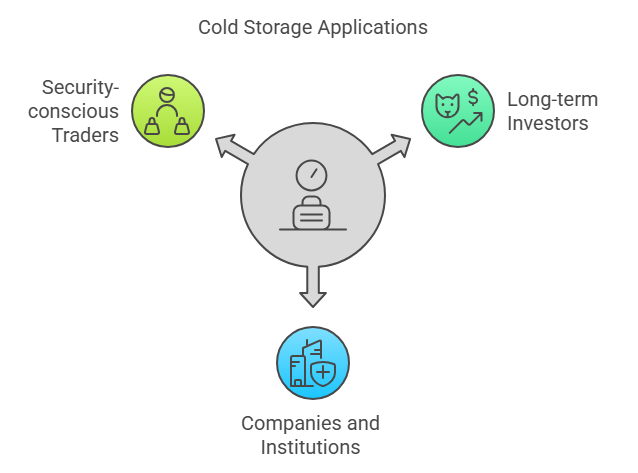
When Cold Storage May Be Relevant
Cold storage is generally discussed when a person or organization wants stronger separation between private keys and everyday internet-connected systems.
Relevant considerations include:
- How frequently transactions need to be signed
- Whether direct key control is required
- Whether the user can manage backups safely
- Whether multiple people require controlled access
- Whether the system must support inheritance or business continuity
- Whether the wallet interacts regularly with smart contracts
- Whether the user can verify addresses and transaction details
- Whether physical storage can be secured appropriately
These factors describe operational requirements. They do not determine how much cryptocurrency a person should acquire, hold, trade, or place in any wallet.
Conclusion
Cryptocurrency cold storage is a method of isolating private keys from online systems. Its purpose is to reduce the opportunities for remote attackers, malicious software, or compromised online services to obtain those keys.
The method can involve hardware wallets, air-gapped signers, offline computers, recovery backups, or institutional custody systems. These components perform different roles and should not be treated as interchangeable.
Cold storage also introduces responsibilities. Recovery information must remain confidential and available. Transactions must be reviewed before signing. Devices, software, backups, and physical storage all require protection.
The central question is not whether a wallet is described as “cold.” It is whether the complete key-management process protects the keys during generation, storage, use, backup, recovery, and eventual replacement.

Frequently Asked Questions
Is Cold Storage Completely Offline?
Not always.
An air-gapped computer may remain disconnected from networks, while a hardware wallet may communicate with an internet-connected device. The defining issue is whether the private keys remain isolated and are prevented from entering the online system.
Is a Hardware Wallet the Same as Cold Storage?
No. A hardware wallet is a device that can form part of a cold-storage arrangement. Cold storage also includes the setup process, recovery backups, physical protection, transaction verification, and access procedures.
Can Cryptocurrency in Cold Storage Be Stolen?
Yes. Cold storage reduces some online attack paths, but loss can still occur through recovery-phrase theft, fraudulent transactions, compromised devices, unsafe key generation, physical theft, coercion, or human error.
Can a Hardware Wallet Be Hacked?
No device should be treated as immune from attack.
The practical security of a hardware wallet depends on its design, firmware, setup, supply chain, connected software, recovery process, and the user’s ability to verify transactions.
What Happens if a Cold Wallet Is Lost?
The answer depends on the recovery system.
A compatible recovery phrase or backup may allow the wallet to be restored. Without a valid recovery method, access may be permanently lost.
Is a Metal Backup a Cold Wallet?
No. A metal backup usually stores recovery information in a physically durable form. It does not normally create keys, manage addresses, or sign transactions.
Are Paper Wallets Still Used?
They still exist, but traditional single-key paper wallets are generally considered a legacy approach.
Creating and spending from one safely can require careful control of key-generation software, printers, computers, temporary files, and transaction handling.
Does Cold Storage Prevent Phishing?
No. It can keep private keys away from an online computer, but it cannot stop someone from entering a recovery phrase into a fraudulent website or signing a harmful transaction.
Should Every Cryptocurrency Account Use Cold Storage?
There is no universal answer.
Different systems provide different levels of access, isolation, backup responsibility, and technical complexity. The appropriate architecture depends on operational and security requirements, not a general rule about asset allocation.
What Is the Most Important Cold-Storage Rule?
Protect the private keys and recovery information throughout their entire lifecycle.
Offline storage alone is not enough if the backup is exposed, the transaction is not verified, or the recovery procedure is unreliable.
1 thought on “What Is Cryptocurrency Cold Storage? A Practical Security Guide”