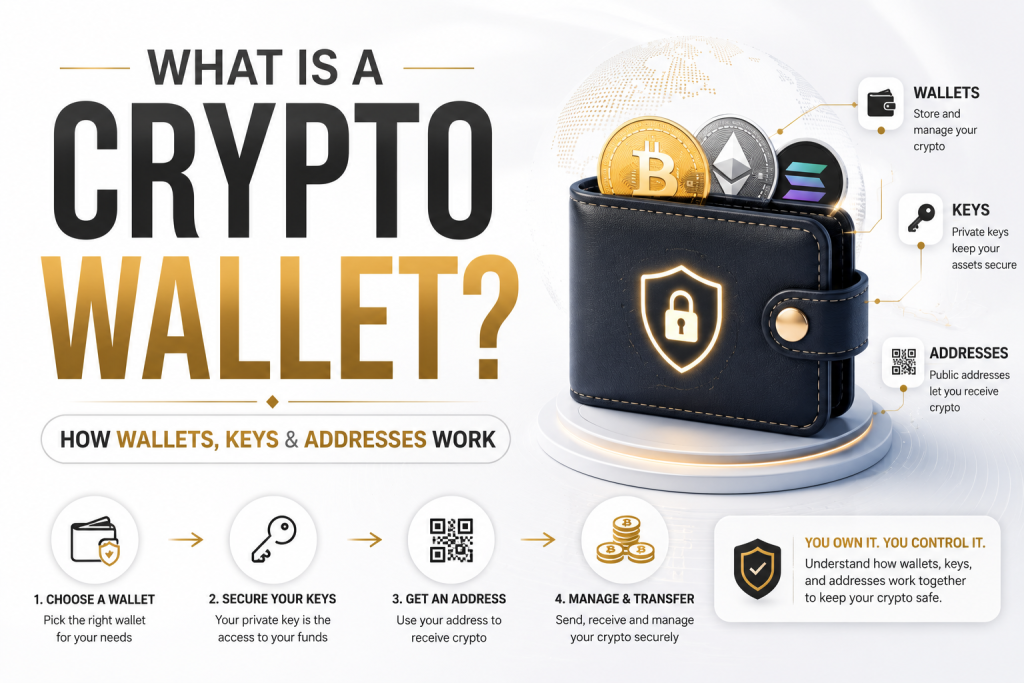
A crypto wallet is a tool for managing blockchain accounts, addresses, keys, and transactions.
Despite the name, a wallet does not hold cryptocurrency in the same way a physical wallet holds cash. The relevant balances and transaction records remain on the blockchain. The wallet provides the information and signing functions needed to interact with those records.
Some wallets operate as mobile applications or browser extensions. Others use dedicated hardware, offline devices, smart contracts, or custodial services. Each model creates different trade-offs involving access, recovery, privacy, convenience, and responsibility.
This guide explains what crypto wallets do, how private keys and recovery phrases fit into the system, and how the main wallet types differ.
Key Takeaways
- A crypto wallet manages the keys and transaction functions used to interact with blockchain accounts.
- Cryptocurrency is recorded on the blockchain rather than stored inside the wallet application or device.
- A wallet address is public information used to identify a destination or account. A private key provides cryptographic signing authority and must remain secret.
- Some wallets generate recovery phrases that can reconstruct several accounts and private keys.
- Software, hardware, smart-contract, custodial, and watch-only wallets use different security and recovery models.
- Hot and cold describe a wallet’s relationship with internet-connected systems. Custodial and self-custodial describe who controls transaction authorization.
- A wallet can protect private keys while still signing a fraudulent or incorrect transaction.
- No wallet type is universally safest. Security depends on the complete process for key generation, storage, signing, backup, recovery, and software maintenance.
Educational notice: This article provides general information about cryptocurrency wallets and blockchain security. It does not provide investment, financial, legal, tax, or individualized cybersecurity advice. Wallet features, recovery procedures, and network compatibility vary. Consult the official documentation for the wallet and blockchain network you use before handling private keys, recovery phrases, or transactions.
Affiliate disclosure: Some links on this website may be affiliate links. The publisher may receive compensation if a reader makes a purchase through one of those links. Commercial relationships do not determine the editorial conclusions presented in this guide.
What Is a Crypto Wallet?
A crypto wallet is software, hardware, or another system that manages the information required to interact with a blockchain account.
Depending on its design, a wallet may:
- Generate private and public keys
- Derive blockchain addresses
- Display account balances and transaction history
- Prepare transactions
- Create digital signatures
- Submit signed transactions to a network
- Connect with blockchain applications
- Restore accounts through a supported recovery method
The Bitcoin Developer Guide describes wallet programs as tools that create public keys for receiving bitcoin and use corresponding private keys to authorize spending. It also explains that these functions can be divided between separate programs, such as an online wallet that prepares transactions and an offline wallet that signs them.
Ethereum.org describes a wallet as a tool for interacting with an Ethereum account. A wallet can display account information, send transactions, and connect to applications without being the place where the blockchain’s records physically reside.
A wallet is therefore better understood as an account and signing interface than as a container for cryptocurrency.
What Does a Crypto Wallet Actually Do?
Not every wallet performs every function. A hardware wallet may focus on signing, while a watch-only wallet may display activity without possessing any signing keys.
Most wallet systems perform some combination of the following tasks.
Manage Key Material
A wallet may generate, import, store, or use private keys.
The private key is the secret cryptographic information used to produce a valid digital signature. The signature allows a blockchain network to verify that a transaction meets the authorization rules for the relevant account or funds.
Generate or Display Addresses
Wallets display public addresses that can be used to identify accounts or transaction destinations.
One wallet may manage many addresses. This is common in Bitcoin wallets, multi-account wallets, and applications supporting several blockchain networks.
For a detailed explanation, see What Is a Crypto Wallet Address?.
Read Blockchain Information
Wallets usually connect to a node, service provider, or blockchain data source to display:
- Balances
- Transaction history
- Token information
- Network fees
- Contract activity
- Pending transactions
The wallet interface interprets information from the network. It does not independently create the authoritative ledger.
Prepare Transactions
A wallet collects the information needed to construct a transaction.
This may include:
- The destination
- The asset
- The amount
- A network fee
- Smart-contract instructions
- Token permissions
- Other network-specific data
Sign Transactions
The wallet or a connected signing device uses a private key to create a digital signature.
The private key itself does not need to be transmitted with the transaction. A properly designed wallet can produce the required signature while keeping the private key inside its protected environment.
Broadcast Transactions
After signing, a wallet may submit the transaction to the blockchain network.
Some systems separate these steps. An offline device can sign a transaction while an online application handles preparation and broadcasting. The Bitcoin documentation describes this type of divided workflow for offline signing.

Crypto Wallet vs. Account vs. Address
These terms are related, but they are not interchangeable.
| Term | Meaning |
| Crypto wallet | A tool or system for managing keys, addresses, accounts, and transactions |
| Blockchain account | A network-specific record or identity used to hold state or authorize activity |
| Wallet address | A public identifier used to identify an account, script, contract, or destination |
| Private key | Secret cryptographic information used to produce authorization signatures |
| Exchange account | An account with a company that may control wallet keys on the customer’s behalf |
An Ethereum wallet, for example, can manage several Ethereum accounts from one application. Ethereum.org notes that users can change compatible wallet providers without changing the underlying blockchain account.
Bitcoin wallets often manage multiple keys and addresses. They may also create change addresses as part of their transaction process.
The wallet is the management layer. The account and address are parts of the underlying blockchain system.
How Crypto Wallets Work
The exact process depends on the network and wallet design. A typical self-custodial wallet follows six broad stages.
1. The Wallet Creates or Imports Key Material
A new wallet may generate a private key directly or create a seed from which several private keys can be derived.
Another wallet may import an existing:
- Private key
- Recovery phrase
- Encrypted wallet file
- Hardware signing device
- Multisignature configuration
- Smart-account authorization method
Cryptographic key management involves more than initial generation. The National Institute of Standards and Technology defines key management as the handling of keys throughout their lifecycle, including generation, storage, use, entry, output, and destruction.
2. The Wallet Derives Accounts and Addresses
The wallet uses network-specific rules to create or locate the accounts and addresses it manages.
In a deterministic wallet, one seed may generate a hierarchy containing several accounts and addresses. BIP 44, for example, describes a hierarchy that can organize multiple cryptocurrencies, accounts, receiving addresses, and change addresses.
Not every blockchain or wallet follows BIP 44.
3. The Wallet Retrieves Network Data
The wallet queries a node or another blockchain service to identify:
- Relevant transactions
- Account state
- Available outputs
- Token balances
- Network conditions
- Contract information
This network data lets the wallet present an understandable interface.
4. The Wallet Prepares a Transaction
The wallet converts the user’s requested action into the format required by the network.
That action could be a basic transfer, but it could also involve:
- Calling a smart contract
- Granting token permissions
- Voting in an onchain system
- Exchanging assets through a decentralized application
- Creating a new account or program interaction
5. The Wallet Signs the Transaction
The private key or another approved authorization method creates the required signature.
Ethereum describes transactions as cryptographically signed instructions that update network state. A basic transaction may transfer ETH, while another transaction may execute contract code.
Bitcoin transactions use a different model. They satisfy the spending conditions of existing unspent transaction outputs and create new outputs. A wallet may combine several inputs and produce a recipient output plus a change output.
6. The Transaction Is Broadcast
The signed transaction is submitted to the network.
Nodes or validators determine whether it satisfies the protocol’s requirements. If accepted and included in the blockchain’s confirmed history, the transaction changes the relevant network state or spending records.

The Main Parts of a Crypto Wallet
Several components are frequently grouped under the word wallet. Understanding their roles prevents common security mistakes.
Private Key
A private key is secret cryptographic information used to produce digital signatures.
Anyone who obtains a usable private key may be able to authorize activity for the corresponding account or payment condition.
A private key demonstrates cryptographic control. It does not necessarily prove legal ownership of an asset or account.
Private keys should not be shared with:
- Support representatives
- Websites
- Social media contacts
- Email correspondents
- Messaging applications
- Anyone offering to repair or synchronize a wallet
Ethereum.org states that legitimate services should not request private keys or recovery phrases.
Public Key
A public key is mathematically related to a private key and can be used to verify signatures.
It can normally be disclosed without providing the ability to create the corresponding signature.
A public key is not always the same thing as a wallet address. Some addresses are derived from public keys, while others represent scripts, contracts, or program-controlled accounts.
Wallet Address
A wallet address is a public identifier used by a particular blockchain.
It may represent:
- A user-controlled account
- A payment condition
- A script
- A smart contract
- A program-derived account
- A custodial deposit destination
The address identifies a destination or account. It does not normally provide the secret signing authority required to move assets.
Recovery Phrase
Many wallets generate a recovery phrase, also called a seed phrase or mnemonic phrase.
BIP 39 is one widely implemented method for converting computer-generated randomness into a human-readable word sequence and then into a binary seed. That seed can be used by compatible deterministic wallets to derive several keys and accounts.
Not every wallet uses BIP 39. Recovery compatibility can depend on:
- The wallet standard
- Derivation paths
- Network support
- Account type
- An additional passphrase
- The receiving wallet’s implementation
A recovery phrase may recreate the wallet’s private keys. It should therefore be protected with the same care as the keys themselves.
Wallet Password or PIN
A wallet password or device PIN usually protects access to a specific application, device, or encrypted file.
It is not necessarily the same as a private key or recovery phrase.
Resetting the application or losing the device may bypass or remove the local password. Recovery may then depend on the wallet’s separate backup method.
Optional Wallet Passphrase
Some recovery systems support an additional passphrase.
This passphrase may alter the wallet derived from the recovery phrase. Entering a different passphrase can produce a different set of accounts.
An optional passphrase should not be treated as a normal resettable password. Its behavior and recovery consequences depend on the wallet implementation.
Types of Crypto Wallets
Wallets can be classified in several ways. One wallet may belong to more than one category.
For example, a mobile wallet may be:
- Software-based
- Internet-connected
- Self-custodial
- Multi-network
- Recovery-phrase based
Software Wallets
A software wallet runs as an application.
Common forms include:
- Mobile wallet applications
- Desktop wallets
- Browser extensions
- Web interfaces
- Command-line wallets
Software wallets can provide direct access to blockchain applications and regular transaction functions.
Their security depends partly on the device, operating system, application source, update process, permissions, and recovery setup.
A software wallet should not automatically be described as custodial. Many software wallets allow the user to control their own keys.
Hardware Wallets
A hardware wallet is a dedicated physical device designed to generate, store, or use private keys.
It may connect to another device through USB, Bluetooth, QR codes, near-field communication, or removable media. A connection does not necessarily mean the private key leaves the hardware device.
Hardware wallets can reduce reliance on the security of a normal computer or phone. They still have risks involving firmware, supply chains, physical theft, transaction display, recovery phrases, and user error.
Ethereum’s 2026 security report notes that hardware wallets have their own attack surface and may be lost, damaged, stolen, or affected by opaque supply chains.
See Cold Wallets for Crypto for a fuller comparison of hardware wallets, offline signers, and other cold-wallet systems.
Paper Wallets
A traditional paper wallet contains private-key information or other signing credentials printed on paper.
Paper wallets remove ongoing internet connectivity, but their safety depends on:
- How the key was generated
- Whether the computer or printer was compromised
- Whether temporary copies were created
- How the paper is protected
- How the key is later imported or used
Paper wallets are generally better understood as a legacy key-storage method than as a simple alternative to modern wallet software.
A paper recovery-phrase backup is not the same thing as a traditional paper wallet containing an individual private key.
Watch-Only Wallets
A watch-only wallet can display addresses, balances, and transaction activity without possessing the private keys needed to authorize spending.
It may be used to:
- Monitor an account
- Prepare unsigned transactions
- Separate viewing from signing
- Track business or organizational addresses
- Work with an offline signing device
A watch-only wallet can improve key isolation, but it does not make the displayed data or prepared transaction inherently trustworthy.
Multisignature Wallets
A multisignature wallet requires a defined threshold of signatures.
A two-of-three arrangement, for example, requires any two of three approved keys to authorize a transaction.
Multisignature systems may distribute keys across:
- Several devices
- Different people
- Separate locations
- An organization and a custody provider
They can reduce reliance on one key, but they also increase setup, documentation, coordination, and recovery complexity.
Smart-Contract Wallets
A smart-contract wallet uses blockchain code to define its authorization rules.
Depending on the implementation, it may support features such as:
- Multiple authorization methods
- Spending restrictions
- Social or organizational recovery
- Session permissions
- Transaction batching
- Alternative fee arrangements
- Replaceable or rotating signers
ERC-4337 describes an Ethereum account-abstraction system that allows smart-contract accounts to use custom verification logic rather than relying only on a traditional externally owned account.
Smart-contract wallets introduce different dependencies. Their security may depend on contract code, upgrade mechanisms, recovery participants, supporting services, and network compatibility.

Hot Wallet vs. Cold Wallet
Hot and cold describe how wallet keys or signing systems relate to internet-connected environments.
| Consideration | Hot Wallet | Cold Wallet |
| Connectivity | Operates in an internet-connected environment | Keeps signing keys offline or isolated |
| Access | Usually direct and convenient | Usually requires an additional signing step |
| Remote attack exposure | Generally greater | Reduced when correctly implemented |
| Physical responsibility | Varies | Often greater |
| Typical form | Mobile, browser, desktop, web | Hardware signer, air-gapped device, offline computer |
| Recovery | Depends on wallet design | Depends on wallet and backup design |
Cold does not automatically mean secure. A compromised recovery phrase can bypass the protection of an otherwise well-designed cold wallet.
Hot does not automatically mean unsafe. Security depends on the device, software, custody model, permissions, recovery process, and activity being authorized.
For broader offline key-management considerations, see What Is Cryptocurrency Cold Storage?.
Custodial vs. Self-Custodial Wallets
Custody describes who controls the authorization method.
Self-Custodial Wallet
In a self-custodial wallet, the user controls the private keys or other credentials needed to authorize transactions.
The provider may supply the interface or software without holding the keys.
Ethereum.org notes that self-custodial wallet providers generally provide a tool for interacting with an account rather than custody over the assets themselves.
Self-custody gives the user direct responsibility for:
- Protecting keys
- Maintaining backups
- Verifying transactions
- Understanding recovery
- Managing device loss
- Planning for incapacity or death
Custodial Wallet or Account
In a custodial system, a company controls or participates in the authorization process.
The customer may sign in with:
- A username and password
- Multifactor authentication
- Identity verification
- A platform-managed recovery process
The customer depends on the custodian’s:
- Security controls
- Withdrawal policies
- Operational availability
- Financial condition
- Legal obligations
- Account-recovery process
A custodial service may use cold storage internally. That does not make the customer self-custodial.
The Core Difference
| Question | Self-Custodial | Custodial |
| Who controls transaction authorization? | The user or user-defined system | The provider or a shared arrangement |
| Who manages key recovery? | Primarily the user | Primarily the provider |
| Can the provider normally reset access? | Often no | Often yes, subject to policy |
| Does the user depend on provider withdrawals? | Usually no | Usually yes |
| Who bears backup responsibility? | The user | The provider, with customer account controls |
Neither model removes risk. They place responsibility and trust in different locations.
How Wallets Handle Transactions
A wallet transaction involves more than selecting an amount and pressing a confirmation button.
The wallet may ask the user to authorize:
- A direct transfer
- A smart-contract call
- A token approval
- A swap
- A message signature
- A governance vote
- A staking action
- An account-permission change
The wallet can protect the private key while still signing a harmful instruction.
A signing interface therefore needs to communicate what is being authorized. This becomes more difficult when contract data is complex or not translated into clear language.
Ethereum transactions can transfer value or execute contract code. The receiving address may belong to a person-controlled account or a contract.
Bitcoin transactions may consume several existing outputs and create several new outputs. The address shown in the interface is only one part of the complete transaction.
Common Crypto Wallet Risks
Recovery-Phrase Exposure
Anyone who obtains a usable recovery phrase may be able to reconstruct the wallet elsewhere.
Ethereum.org warns that screenshots of recovery phrases or private keys may synchronize to cloud services and become accessible to attackers.
Fake Support and Phishing
Scammers may impersonate:
- Wallet providers
- Exchanges
- Hardware manufacturers
- Blockchain foundations
- Customer-support representatives
- Security teams
The FTC has documented phishing messages that imitate wallet and payment companies, create urgency, and direct users to fake websites or phone numbers.
Malicious Transaction Signing
A wallet can correctly sign the wrong transaction.
Potential problems include:
- An attacker-controlled address
- An unexpected amount
- A malicious contract call
- Excessive token permissions
- An unclear message signature
- A transaction on the wrong network
Fake Wallet Applications
Fraudulent applications may imitate legitimate wallet software or websites.
An application can display familiar branding while capturing recovery phrases, replacing addresses, or creating attacker-controlled accounts.
Compromised Devices
Malware may:
- Read clipboard data
- Replace addresses
- Alter browser content
- Record keystrokes
- Capture screenshots
- Modify transaction requests
- Redirect users to imitation websites
A separate signing device may reduce some of these risks but cannot eliminate fraudulent approvals.
Physical Loss or Damage
A wallet device can be lost, stolen, destroyed, or rendered unusable.
Recovery depends on the backup method and compatibility of the replacement system.
Supply-Chain Risk
A device or software package may be altered before reaching the user.
Unexpected preconfigured recovery phrases, unofficial download links, and modified setup instructions are warning signs.
Recovery Failure
A recovery phrase may fail to display the expected accounts when the wallet uses:
- A different derivation path
- An additional passphrase
- An unsupported network
- A nonstandard backup format
- A smart-account recovery system
- Missing configuration data
A backup should not be assumed compatible with every wallet application.

How to Evaluate a Crypto Wallet
Wallet evaluation should begin with the security and operational requirements rather than a brand name.
Custody Model
Determine who controls transaction authorization.
A provider’s use of terms such as secure, decentralized, or wallet does not answer whether the user controls the keys.
Supported Networks and Assets
Confirm which networks, account types, tokens, and transaction functions are supported.
A wallet may display an address format without supporting every asset or contract on that network.
Recovery Method
Identify:
- What information restores the wallet
- Whether the recovery method follows a documented standard
- Whether an additional passphrase is involved
- Which compatible applications can perform recovery
- What happens if the provider stops operating
Transaction Display
Consider whether the wallet displays understandable information about:
- Destination addresses
- Amounts
- Fees
- Networks
- Contract calls
- Token permissions
- Message signatures
An isolated private key offers limited protection when the user cannot understand what the wallet is signing.
Software Maintenance
Review whether the provider publishes:
- Current updates
- Security notices
- Supported versions
- Vulnerability-reporting information
- Recovery documentation
- Authentic download locations
Hardware and Software Transparency
Open-source code can permit external inspection, but source availability alone does not prove that the installed software matches the published code or that the implementation is free from vulnerabilities.
Closed-source software may provide less public visibility into its implementation.
Neither label should be treated as a complete security verdict.
Complexity
Additional accounts, devices, passphrases, signers, recovery participants, and storage locations may increase resilience.
They may also increase the chance of configuration errors or failed recovery.
Continuity
A wallet system may need to account for:
- Device failure
- Software obsolescence
- Provider closure
- Lost credentials
- Owner incapacity
- Organizational staff changes
- Inheritance requirements
The appropriate process depends on the user’s legal, technical, and operational circumstances.
Common Crypto Wallet Misconceptions
“A Crypto Wallet Stores Cryptocurrency”
The blockchain records the relevant balances, outputs, accounts, and transactions.
The wallet manages the keys and tools used to interact with those records.
“The Wallet Company Controls Every Wallet”
Some wallet providers control customer keys. Others provide self-custodial software and cannot reset or reconstruct the user’s private keys.
The custody model must be checked directly.
“A Password Can Always Recover the Wallet”
A local wallet password may only unlock an application or encrypted device.
It may not replace the private key, recovery phrase, or other required backup.
“Anyone Who Knows the Address Can Spend the Funds”
A public address does not normally contain the private signing authority required to authorize spending.
It may still reveal public transaction history and support targeted scams.
“A Hardware Wallet Cannot Be Hacked”
Hardware wallets reduce certain forms of exposure. They still have firmware, supply-chain, physical, recovery, and transaction-verification risks.
“A Recovery Phrase Works in Every Wallet”
Compatibility depends on standards, derivation paths, account types, networks, passphrases, and wallet implementation.
“Self-Custody Removes Third-Party Risk”
Self-custody reduces dependence on a custodian for transaction authorization.
It may still depend on wallet software, node providers, hardware manufacturers, smart contracts, applications, and network infrastructure.
Conclusion
A crypto wallet is a key-management and transaction tool.
It may generate accounts, display addresses, retrieve blockchain information, prepare transactions, create digital signatures, and connect with blockchain applications. The cryptocurrency itself remains represented by records on the relevant network.
Wallets differ in how they store keys, connect to networks, recover access, and assign responsibility. Software wallets, hardware wallets, multisignature systems, smart-contract wallets, custodial accounts, and watch-only applications solve different problems.
The most important distinction is not the wallet’s label. It is how the complete system handles authorization, transaction review, backup, recovery, software maintenance, and long-term access.
Frequently Asked Questions
What Is a Crypto Wallet?
A crypto wallet is software, hardware, or another system used to manage blockchain accounts, keys, addresses, and transactions.
Does a Crypto Wallet Hold Cryptocurrency?
Not in the same way that a physical wallet holds cash.
The blockchain records the relevant balances, transactions, accounts, or unspent outputs. The wallet manages the keys and interface used to interact with those records.
Is a Crypto Wallet the Same as a Crypto Address?
No. A wallet may manage several addresses. An address is a public network identifier, while the wallet provides broader account and transaction functions.
Is a Wallet Address Safe to Share?
A receiving address is generally intended to be public.
Sharing it does not normally provide spending authority, but it may expose transaction activity and allow others to monitor the address.
What Is the Difference Between a Private Key and a Recovery Phrase?
A private key authorizes activity for a particular account or payment condition.
A recovery phrase may generate or restore several private keys and accounts in a compatible wallet system.
Can a Wallet Provider Recover a Lost Wallet?
It depends on the custody model.
A custodial provider may have an account-recovery process. A self-custodial wallet provider may be unable to restore access without the user’s recovery information.
Ethereum.org states that lost private keys or seed phrases cannot be reset for basic self-custodial Ethereum accounts.
Is a Hardware Wallet Better Than a Software Wallet?
Neither is universally better.
Hardware wallets provide stronger key isolation in some environments. Software wallets may provide simpler access and application connectivity. Each model has different risks.
Can One Wallet Support Several Blockchains?
Yes. Some wallets support multiple networks, but compatibility varies by wallet, asset, account type, and feature.
Using the same interface does not combine the separate blockchains.
What Is a Smart-Contract Wallet?
A smart-contract wallet uses blockchain code to define some or all of its authorization rules.
It may support features such as multiple signers, programmable permissions, recovery participants, or transaction limits.
What Happens if a Wallet Device Is Lost?
The outcome depends on the recovery setup.
A supported recovery phrase or backup may restore access on compatible software or hardware. Without valid recovery information, access may be permanently lost.
Can a Crypto Wallet Be Hacked?
Wallet systems can be compromised through malware, phishing, stolen recovery information, malicious software, hardware attacks, supply-chain interference, physical access, or fraudulent transaction approvals.
No wallet should be treated as immune from attack.