A crypto recovery phrase is a sequence of words used by many self-custodial wallets to recreate the cryptographic information behind a wallet.
It may restore several accounts, addresses, and private keys. This makes the recovery phrase more important than the original wallet application or hardware device. A lost device may be replaceable. An exposed recovery phrase may allow another person to reconstruct the wallet without possessing that device.
The terms recovery phrase, seed phrase, and mnemonic phrase are often used interchangeably. Technically, they can describe different stages of the recovery process. The words may be converted into a binary seed, which a compatible wallet then uses to derive private keys and accounts.
This guide explains how recovery phrases work, how they differ from private keys and passphrases, what they can restore, and why a wallet may appear empty after recovery.
Key Takeaways
- A recovery phrase can recreate the cryptographic seed from which a compatible wallet derives private keys and accounts.
- The recovery phrase is not the cryptocurrency itself. Blockchain networks record the accounts, balances, and transactions.
- The terms recovery phrase and seed phrase are commonly used as synonyms, but a BIP 39 mnemonic is technically converted into a separate binary seed.
- BIP 39 supports phrases containing 12, 15, 18, 21, or 24 words.
- A recovery phrase may control several accounts. A private key generally authorizes activity for a more specific account or signing relationship.
- An optional passphrase changes the resulting wallet. A missing, misspelled, or incorrectly capitalized passphrase may open a different wallet without displaying an error.
- Correct recovery words may still produce an apparently empty wallet when the derivation path, network, account type, passphrase, or wallet standard differs.
- Anyone who obtains a usable recovery phrase may be able to restore the wallet without the original device or local password.
- Not every wallet uses a recovery phrase. Smart-contract wallets, custodial accounts, multisignature systems, and newer recovery models may use different methods.
Educational notice: This article provides general information about cryptocurrency wallet security. It does not provide investment, financial, legal, tax, or individualized cybersecurity advice. Wallet recovery procedures vary by provider, network, account type, and backup standard. Consult the official documentation for the wallet you use before entering recovery information.
Affiliate disclosure: Some links on this website may be affiliate links. The publisher may receive compensation if a reader makes a purchase through one of those links. Commercial relationships do not determine the editorial conclusions presented in this guide.
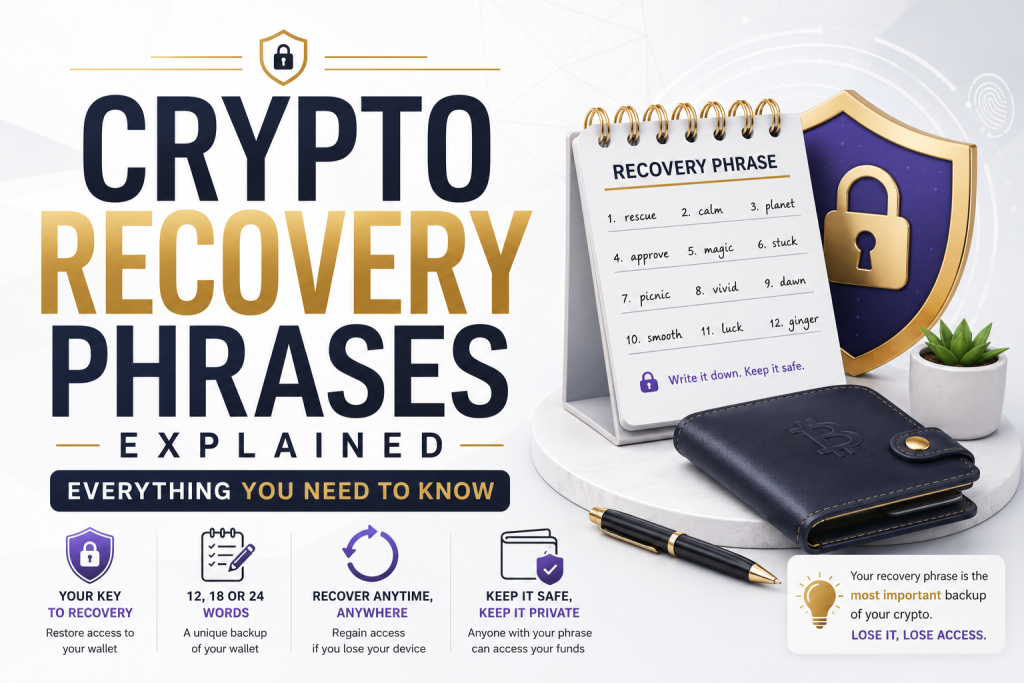
What Is a Crypto Recovery Phrase?
A crypto recovery phrase is a human-readable representation of information used to recover a cryptocurrency wallet.
It normally appears as an ordered list of words, such as 12 or 24 words selected from a standardized word list.
The phrase may allow compatible wallet software to reconstruct:
- A cryptographic seed
- A hierarchy of private keys
- Public keys
- Blockchain addresses
- Several wallet accounts
The phrase does not download cryptocurrency from the original device. It recreates the signing information needed to identify and interact with accounts already recorded on blockchain networks.
Ethereum.org describes a recovery phrase as the master key to a wallet and warns that anyone who obtains it may gain access to all accounts derived from it.
A recovery phrase is not the same as:
- A wallet address
- An application password
- A hardware-wallet PIN
- A private key for one account
- An exchange login
- A customer-support recovery code
Those elements serve different purposes.
Recovery Phrase vs. Seed Phrase
The terms recovery phrase and seed phrase are often used interchangeably in wallet interfaces and educational material.
That usage is understandable, but the technical distinction is useful.
Recovery Phrase
The recovery phrase is the ordered list of words recorded by the user.
It may also be called:
- A mnemonic phrase
- A mnemonic sentence
- A wallet backup
- A secret recovery phrase
- A recovery seed
Seed
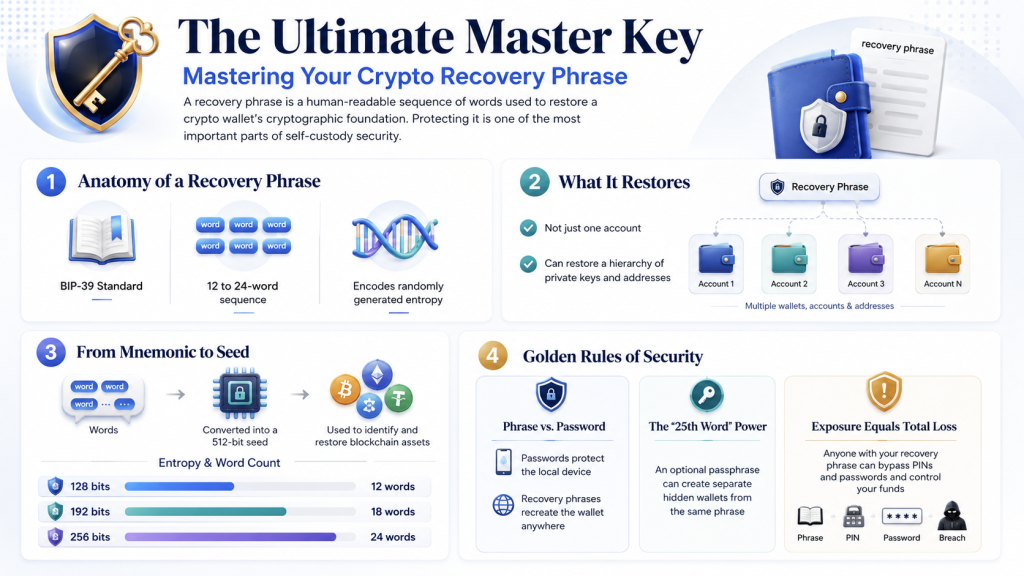
In BIP 39, the mnemonic sentence is processed with an optional passphrase to create a binary seed.
That binary seed can then be used by a hierarchical deterministic wallet to derive private keys and accounts.
The official BIP 39 specification describes two separate stages:
- Generating the mnemonic sentence
- Converting the mnemonic into a binary seed
That seed can then be used with BIP 32 or another deterministic wallet system.
In ordinary conversation, “seed phrase” usually means the recovery words. In precise technical writing, the phrase and the resulting seed are related but not identical.
How a Recovery Phrase Works
A typical BIP 39 wallet recovery process involves several connected steps.
1. The Wallet Generates Random Data
The wallet begins with computer-generated randomness, usually called entropy.
BIP 39 supports entropy lengths from 128 to 256 bits in increments of 32 bits. The wallet adds checksum information and divides the result into sections that correspond to words from a standardized list. (BIP 39)
This produces standard phrase lengths:
| Entropy | Recovery-Phrase Length |
| 128 bits | 12 words |
| 160 bits | 15 words |
| 192 bits | 18 words |
| 224 bits | 21 words |
| 256 bits | 24 words |
The words are not selected because they form a meaningful sentence. They encode randomly generated information plus a checksum.
2. The Words Are Converted Into a Seed
The wallet processes the mnemonic sentence through a password-based key-derivation function.
Under BIP 39, the wallet combines:
- The mnemonic sentence
- The word mnemonic
- An optional user-supplied passphrase
The result is a 512-bit binary seed. (BIP 39)
3. The Seed Generates a Wallet Hierarchy
A hierarchical deterministic wallet can use the seed to generate a master key and a tree of child keys.
BIP 32 defines a hierarchical deterministic wallet structure that allows many related private and public keys to be derived from one starting point.
This is why one recovery phrase may restore many addresses rather than one account.
4. Derivation Paths Organize the Accounts
A derivation path tells wallet software which branch of the key hierarchy to use.
BIP 44 defines a structure that can separate:
- Wallet purposes
- Cryptocurrency types
- Accounts
- External receiving addresses
- Internal or change addresses
- Individual address indexes
The same recovery phrase can therefore produce different addresses when wallet software uses a different derivation path.
5. The Wallet Searches for Relevant Accounts
After deriving addresses, the wallet checks the relevant blockchain networks for transaction activity.
The wallet may need to search several account indexes or derivation paths before displaying all expected accounts.
This is one reason a successful phrase import may not immediately show the balance or account a user expects.
What Is BIP 39?
BIP 39 is a widely implemented standard for creating mnemonic sentences and converting them into deterministic wallet seeds.
It defines:
- Permitted entropy sizes
- Checksum construction
- Mnemonic phrase lengths
- Standardized word lists
- The process for deriving a binary seed
- Support for an optional passphrase
BIP 39 does not define the complete wallet.
Other standards or wallet-specific rules may determine:
- How keys are derived from the seed
- Which blockchain is used
- Which account number is selected
- Which address format appears
- How the wallet searches for existing accounts
BIP 32 and BIP 44 are commonly discussed alongside BIP 39 because they describe deterministic key hierarchies and account organization.
Not every recovery phrase follows BIP 39. A phrase with a different word count or structure may use another standard or a provider-specific recovery system.
Recovery Phrase vs. Private Key
A recovery phrase and a private key are related, but they do not perform the same role.
| Recovery Phrase | Private Key |
| May recreate a wallet seed | Produces cryptographic signatures |
| May derive several private keys | Usually belongs to a specific account or signing branch |
| Often contains 12 to 24 words | Usually represented as binary, hexadecimal, or another encoded format |
| Used primarily for wallet recovery | Used to authorize transactions or messages |
| May restore several accounts and networks | Provides narrower signing authority |
Importing a private key may restore one account.
Importing a recovery phrase may recreate a complete deterministic wallet containing several accounts. MetaMask, for example, distinguishes between importing an entire wallet through a secret recovery phrase and importing one account through a private key.
A recovery phrase should not be described as one large private key. It is backup information from which a wallet may derive many keys.
For broader wallet terminology, link this section to your planned What Is a Crypto Wallet? pillar page.
Recovery Phrase vs. Wallet Password or PIN
A wallet password or hardware-device PIN normally protects local access.
It may:
- Unlock a wallet application
- Decrypt locally stored wallet data
- Unlock a hardware device
- Prevent casual access to a browser extension
- Protect access from someone holding the device
The password or PIN usually does not replace the recovery phrase.
A person who has the recovery phrase may be able to recreate the wallet on another compatible device without knowing the original application password or hardware PIN. MetaMask describes its secret recovery phrase as the information used to restore the wallet and its associated accounts on another device.
This leads to an important distinction:
- The password or PIN protects one installation or device.
- The recovery phrase may recreate the wallet somewhere else.
The exact behavior depends on the wallet.
Recovery Phrase vs. Optional Passphrase
An optional passphrase is additional text combined with the mnemonic sentence during seed generation.
It is sometimes informally called:
- The 25th word
- An extra word
- A hidden-wallet password
- A BIP 39 passphrase
“25th word” is not a precise name. A passphrase can contain several words, spaces, numbers, or symbols, depending on the wallet.
The Passphrase Creates a Different Wallet
Under BIP 39, every passphrase produces a valid seed.
That means:
- The correct recovery phrase with no passphrase produces one wallet.
- The same recovery phrase with one passphrase produces another wallet.
- The same recovery phrase with a different passphrase produces another wallet.
- A typo can create a valid but empty-looking wallet.
The wallet may not display an “incorrect passphrase” warning because there is no invalid result to detect. The wrong passphrase simply derives different keys. (BIP 39)
Trezor’s official documentation similarly explains that a passphrase creates a separate wallet linked to the same wallet backup.
Passphrases Are Exact
A passphrase may be case-sensitive.
Differences in capitalization, punctuation, spaces, or spelling can produce a different wallet. Trezor warns that entering a different passphrase creates access to a different passphrase wallet rather than displaying a conventional password error.
Passphrases Are Not Normally Resettable
A provider may not know the passphrase or have a reset mechanism.
Losing it can make the associated wallet inaccessible even when the recovery phrase remains available.
A passphrase therefore adds both protection and recovery complexity.
What Can a Recovery Phrase Restore?
A recovery phrase may restore wallet keys when the receiving software supports the same recovery system.
Ethereum.org states that a seed phrase can be restored through a compatible wallet application and advises users to follow the wallet provider’s official restoration documentation.
Successful recovery may depend on several factors.
The Backup Standard
The receiving wallet must support the phrase’s format.
Examples include:
- BIP 39 mnemonic phrases
- SLIP 39 single-share backups
- SLIP 39 multi-share backups
- Provider-specific backups
- Encrypted recovery files
- Smart-account recovery systems
SLIP 39, for example, supports recovery arrangements based on Shamir’s Secret Sharing and is distinct from a conventional BIP 39 mnemonic.
The Exact Words and Their Order
BIP 39 words must be entered in the correct sequence.
A misspelled, missing, duplicated, or misplaced word may fail checksum validation or produce an unusable phrase.
The Optional Passphrase
The exact passphrase used with the original wallet must also be supplied.
The correct words with the wrong passphrase will derive a different wallet.
The Derivation Path
The receiving wallet must search or support the path used to create the original accounts.
Different wallets may use different paths for:
- Bitcoin address types
- Legacy accounts
- SegWit accounts
- Taproot accounts
- Ethereum accounts
- Other blockchain networks
Ledger’s technical explanation of derivation paths notes that addresses are generated from the wallet seed through network-specific key paths.
The Account Index
A restored wallet may initially display only its first account.
Additional accounts may need to be rediscovered or added according to the wallet’s documented process.
The Network and Asset
The same wallet may derive accounts for several blockchains.
The interface must connect to the relevant network and recognize the associated assets before it can display them.
Additional Wallet Configuration
Some systems require information beyond one phrase.
Examples may include:
- Multisignature configuration
- Extended public keys
- Cosigner details
- Smart-contract wallet addresses
- Guardian or recovery-module information
- Account descriptors
- A separate passphrase
- Provider-managed authentication
A recovery phrase should not be assumed to contain every piece of information used by every wallet architecture.
Why Can a Restored Wallet Show a Zero Balance?
An empty-looking wallet does not always mean the recovery phrase is wrong or that blockchain assets have disappeared.
Common explanations include the following.
The Wrong Passphrase Was Entered
A different passphrase generates a different seed and different accounts.
Even a minor difference can open a valid wallet with no transaction history.
The Wallet Uses a Different Derivation Path
The software may be checking a different branch of the key hierarchy.
This is particularly relevant when restoring older wallets or switching between wallet providers. BIP 44 defines one account hierarchy, but wallets may also use network-specific or address-specific paths.
The Expected Account Has Not Been Added
The original activity may have occurred under account number two, three, or another later account.
The new wallet may initially display only the first account.
The Wrong Blockchain Is Selected
A multi-network wallet may derive related accounts across several networks.
An Ethereum account will not display Bitcoin activity. Activity on one Ethereum-compatible network may also remain separate from activity on another network, even when the displayed address is the same.
The Asset Is Not Displayed by the Interface
A token or network may need to be enabled before it appears.
This is an interface issue rather than proof that the blockchain account is empty.
The Original Wallet Was Multisignature
One recovery phrase may restore one signer without recreating the complete multisignature wallet.
The wallet may also require the other cosigners’ public information, the signing threshold, and the original account configuration.
The Account Was a Smart-Contract Wallet
A recovery phrase may restore the signing account but not automatically rediscover the separate smart-contract account it controlled.
Programmable accounts can use custom validation and recovery logic instead of depending exclusively on one conventional private key.
The Wallet Has Not Finished Synchronizing
The application may still be retrieving blockchain data or may be experiencing a node, indexer, or network problem.
The wallet provider’s official troubleshooting documentation should be used before concluding that the recovery failed.
What Happens if a Recovery Phrase Is Lost?
The consequences depend on whether access to the original wallet still exists.
The Wallet Is Still Accessible
If the wallet or signing device still works, the user may still be able to access the accounts.
However, the missing backup creates a future recovery risk if the device fails, is lost, or becomes unusable. The correct response depends on the wallet’s design and official documentation.
Some providers document procedures for creating a new wallet with a new recovery phrase and moving account control to the new addresses. Those procedures are product-specific and may involve network fees, token permissions, smart contracts, or other complications.
The Wallet Is No Longer Accessible
If the device, application, private keys, and valid recovery method are all unavailable, restoration may be impossible.
Ethereum.org states that basic self-custodial account credentials cannot be reset by a central authority.
This is a defining difference between many self-custodial wallets and traditional online accounts.
What Happens if a Recovery Phrase Is Exposed?
An exposed recovery phrase should be treated as compromised.
Anyone who obtains it may be able to:
- Restore the wallet through compatible software
- Derive associated private keys
- Monitor the accounts
- Sign transactions
- Transfer supported assets
- Create automated scripts that watch for future deposits
The attacker does not normally need the original hardware device, wallet password, or PIN. MetaMask states that whoever controls the secret recovery phrase controls the wallet.
Creating another account under the same compromised phrase does not solve the problem. The new account may be derived from the same exposed seed. MetaMask specifically warns against creating additional accounts under a compromised recovery phrase.
Wallet providers generally recommend creating completely new recovery information in a trusted environment and migrating control according to their official procedures. The exact steps depend on the wallet, network, assets, smart-contract permissions, and whether an active attacker is monitoring the account.
Do not follow migration instructions sent through unsolicited messages or private support channels.
Common Recovery-Phrase Scams
Recovery phrases are frequent targets because they can bypass many device-level protections.
Fake Customer Support
An impersonator claims that the wallet requires:
- Verification
- Synchronization
- Reactivation
- Validation
- An upgrade
- Emergency protection
- Account recovery
The person then asks for the recovery phrase.
MetaMask states that its support personnel will never ask for a secret recovery phrase.
Fake Wallet Websites
A fraudulent website imitates a wallet provider and displays a form asking the user to “connect,” “restore,” or “validate” the wallet by entering recovery words.
Legitimate decentralized applications do not need the recovery phrase merely to connect a wallet.
Fake Wallet Applications
A malicious application may imitate an established wallet and request a phrase during setup or account import.
Applications and browser extensions should be obtained through the provider’s verified channels.
Prewritten Recovery Phrases
A hardware wallet arrives with recovery words already printed inside the box.
This is a major warning sign. The person who supplied the words may already control the resulting wallet. Ledger warns that using a prewritten phrase can allow someone else to take control of the associated accounts.
A legitimate self-custodial wallet should generate new recovery information through its documented initialization process.
Cloud-Storage and Screenshot Exposure
A screenshot may be uploaded automatically through:
- Photo synchronization
- Device backups
- Shared albums
- Cloud-storage services
- Messaging applications
Ethereum.org warns that screenshots containing recovery information may synchronize to cloud services and become accessible to attackers.
Social Engineering and Urgency
Scammers may claim:
- The account is under attack.
- A transaction must be canceled.
- The wallet will be suspended.
- A security update is mandatory.
- A recovery attempt occurred in another country.
- Immediate action is required.
A recovery phrase should not be disclosed because a caller or message creates urgency.
Common Recovery-Phrase Mistakes
Choosing the Words Manually
A BIP 39 phrase should represent wallet-generated randomness.
Selecting familiar words from the list does not create the same security properties. The BIP 39 specification states that its mnemonic is intended to encode computer-generated entropy rather than a sentence invented by the user.
Recording the Words in the Wrong Order
Word order is part of the backup.
The correct words in a different sequence do not represent the same wallet.
Forgetting the Passphrase
A recovery phrase cannot recreate a passphrase-protected wallet without the exact passphrase.
Confusing the PIN With the Passphrase
A device PIN normally unlocks one device.
A BIP 39 passphrase changes the derived wallet.
Entering the Phrase Into an Unverified Device
A recovery procedure exposes the phrase to the device or software receiving it.
A fake application or compromised computer may capture the words.
Assuming Every Wallet Is Compatible
Two wallets may both support BIP 39 but differ in:
- Networks
- Derivation paths
- Account discovery
- Address formats
- Passphrase handling
- Multisignature support
Compatibility should be confirmed through official documentation.
Keeping All Recovery Information Together
Placing a device, recovery phrase, passphrase, and full instructions in one accessible location may create a single point of compromise.
Separating information can reduce some risks, but excessive complexity can also cause failed recovery. The trade-off depends on the wallet architecture and recovery requirements.
Creating Copies Without Tracking Them
Every additional copy may improve availability while increasing the number of places that require protection.
Untracked copies can remain exposed long after the original backup method changes.
How to Evaluate a Recovery Method
A reliable recovery system must protect both confidentiality and availability.
Confidentiality
Unauthorized people should not be able to obtain enough information to recreate the wallet.
Availability
The authorized user must still be able to recover after:
- Device failure
- Physical damage
- Software changes
- Provider closure
- Loss of one backup
- Owner incapacity
- Organizational changes
Accuracy
The backup must preserve:
- The correct words
- The correct order
- The correct passphrase, when applicable
- Any required account configuration
- Any multisignature or smart-account information
Compatibility
The recovery method should have clear documentation explaining which wallets, standards, and networks support it.
Durability
Physical media may be affected by:
- Fire
- Water
- Corrosion
- Fading
- Accidental disposal
- Unauthorized photography
- Theft
Durability does not guarantee confidentiality. A metal backup may survive a fire while remaining readable to anyone who finds it.
Complexity
A sophisticated recovery system is not automatically more reliable.
Multishare arrangements, passphrases, geographically distributed copies, and several cosigners can reduce particular risks. They can also create more ways for recovery to fail.
Do All Crypto Wallets Use Recovery Phrases?
Recovery phrases are common in self-custodial deterministic wallets, but they are not universal.
Custodial Accounts
A centralized service may control the underlying wallet keys and provide account recovery through identity verification, email, passwords, or multifactor authentication.
The customer may never receive the wallet’s recovery phrase.
Smart-Contract Wallets
A programmable wallet may support:
- Recovery guardians
- Replaceable signing keys
- Multiple authentication methods
- Time-delayed recovery
- Social recovery
- Modular account permissions
Ethereum account abstraction allows smart-contract accounts to use custom validation and recovery logic.
Multisignature Wallets
A multisignature wallet may depend on several independent keys.
One phrase may recover only one signer rather than the complete wallet arrangement.
Multishare Backups
A SLIP 39 backup may divide recovery information into several shares. A defined threshold of shares is then required for restoration.
Provider-Specific Recovery Systems
Some wallet systems use encrypted cloud backups, hardware recovery cards, threshold cryptography, or other provider-dependent methods.
The word wallet does not reveal which recovery model is used.
Conclusion
A crypto recovery phrase is a backup for the cryptographic foundation of many self-custodial wallets.
In a BIP 39 system, the words encode wallet-generated randomness. The phrase and an optional passphrase are converted into a seed. A deterministic wallet then uses that seed to derive private keys, accounts, and addresses.
This structure allows one phrase to restore many accounts. It also makes the phrase a critical security risk. A person who obtains it may not need the original device, password, or PIN.
Successful recovery depends on more than having the correct words. The wallet may also require the right passphrase, derivation path, network, account index, address type, and supporting configuration.
A recovery phrase should therefore be understood as part of a broader wallet-recovery system. Its reliability depends on secrecy, accuracy, compatibility, durability, and the ability to reconstruct the original wallet architecture when needed.
Frequently Asked Questions
Is a Seed Phrase the Same as a Recovery Phrase?
The terms are commonly used interchangeably.
Technically, a BIP 39 mnemonic phrase is converted into a binary seed. The phrase and seed are therefore related but not identical.
How Many Words Are in a Recovery Phrase?
BIP 39 supports 12, 15, 18, 21, and 24-word mnemonic phrases.
Other wallet standards may use different word counts.
Can Someone Access a Wallet With Only the Recovery Phrase?
Often, yes. A compatible wallet may use the phrase to recreate the seed, derive private keys, and restore associated accounts. An optional passphrase or other recovery requirement may also be necessary.
Can a Recovery Phrase Be Changed?
The phrase itself normally cannot be edited while retaining the same deterministic wallet.
Creating new recovery information generally creates a new wallet and new accounts. Moving account control to that wallet is a separate blockchain process that should follow the relevant wallet’s official documentation.
Can Two Wallets Use the Same Recovery Phrase?
Two compatible wallet applications can restore accounts derived from the same phrase.
Using the phrase in another wallet does not create an independent backup wallet. Both applications may control the same underlying blockchain accounts.
What Is the 25th Word?
The phrase usually refers to an optional BIP 39 passphrase.
It does not need to be one word. It changes the seed derived from the recovery phrase and therefore creates a different wallet.
Can a Passphrase Be Reset?
Usually not. The wallet provider may not know or store it. A forgotten passphrase can make the associated wallet inaccessible.
Why Does My Recovered Wallet Show No Balance?
Possible causes include:
- An incorrect passphrase
- A different derivation path
- The wrong account index
- The wrong network
- An undisplayed token
- Missing multisignature information
- A separate smart-contract wallet
- Incomplete wallet synchronization
The correct troubleshooting process depends on the original wallet.
Can a Wallet Be Recovered Without the Original Device?
Often, yes. A compatible wallet may restore the accounts using the recovery phrase and any additional required information.
Can a Wallet Company Recover a Lost Phrase?
A self-custodial wallet provider usually does not possess the phrase and may be unable to recreate it.
Custodial and provider-assisted recovery systems operate differently.
Should a Recovery Phrase Be Entered Into a Website?
A normal website, customer-support form, message, or decentralized application should not request it.
Recovery words should only be entered through the wallet’s verified recovery process and official documentation.
Does Every Cryptocurrency Wallet Use BIP 39?
No. Wallets may use BIP 39, SLIP 39, private-key imports, multisignature recovery, smart-account recovery, encrypted files, custodial recovery, or other systems.