Introduction
When analyzing a cryptocurrency, price alone rarely tells the full story. Metrics such as circulating supply play an important role in understanding how a digital asset is valued and how its market dynamics work.
Circulating supply refers to the number of coins or tokens that are currently available for public trading in the market. Because it reflects the portion of a cryptocurrency that is actively accessible to investors and traders, it is widely used when calculating market capitalization and comparing different crypto assets.
Not all tokens created by a project are immediately available in the market. Some may be locked in vesting schedules, reserved for development funds, allocated to early investors, or permanently removed through token burns. As a result, circulating supply often provides a clearer snapshot of the supply that is actually influencing price at any given time.
In this guide, we’ll explore what circulating supply means, how it is calculated, how it differs from total and maximum supply, and why understanding these supply metrics can help provide better context when evaluating cryptocurrency projects.
Key Takeaways
- Circulating supply refers to the number of cryptocurrency tokens that are currently available to the public and actively trading in the market.
- This metric is commonly used to calculate a cryptocurrency’s market capitalization, which helps compare the relative size and valuation of different digital assets.
- Circulating supply may differ from total supply and maximum supply, since some tokens can be locked, reserved, staked, or permanently removed through token burns.
- Changes in circulating supply such as token unlocks, new issuance, or burns can influence how market participants interpret a project’s scarcity and potential value.
- Understanding how supply metrics work can help provide better context when evaluating cryptocurrency projects and their long-term token economics.

What Is Circulating Supply in Cryptocurrency?
Circulating supply refers to the number of cryptocurrency tokens that are currently available to the public and actively trading in the market.
In most projects, not every token that exists is immediately accessible. Some tokens may be locked in vesting schedules, reserved for development funds, allocated to early investors, or temporarily removed from circulation through mechanisms such as staking. Because of this, circulating supply focuses specifically on the portion of tokens that are freely moving in the market.
This metric is widely used when evaluating digital assets because it reflects the supply that is actively influencing price and liquidity.
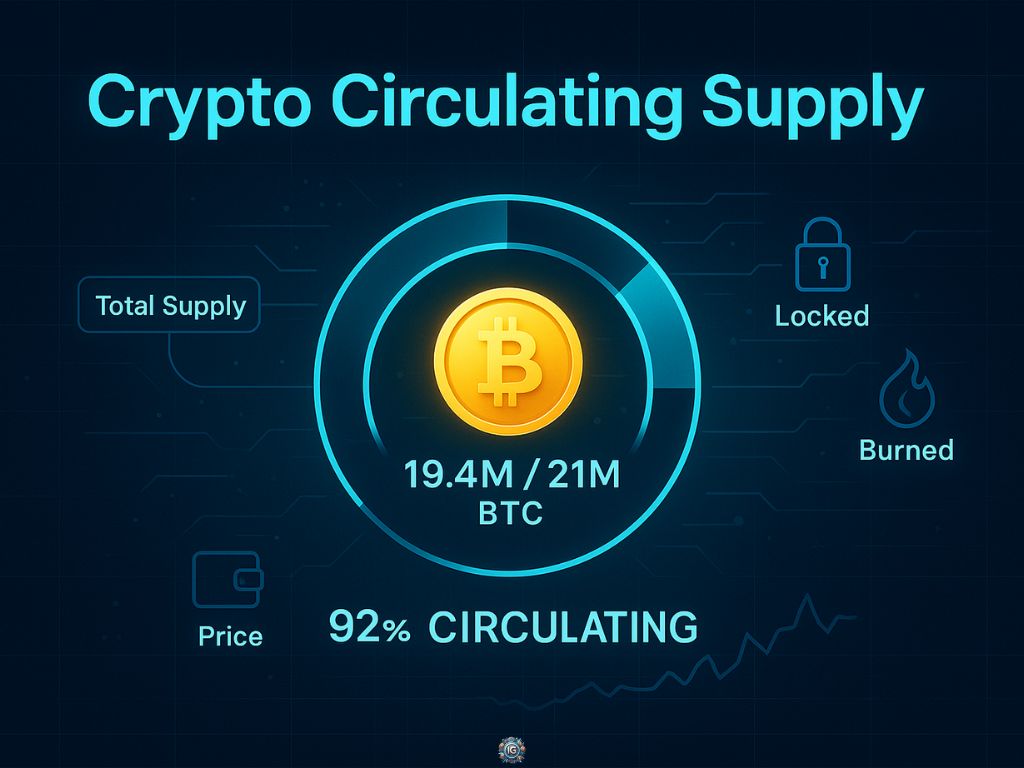
For example, Bitcoin has a maximum supply of 21 million coins, but the circulating supply represents the portion that has already been mined and is available for trading. The remaining coins are gradually introduced through the network’s issuance process.
Understanding circulating supply helps provide context for how scarce a cryptocurrency may be in the market and how supply levels interact with demand to influence price movements.

How Is Circulating Supply Calculated?
Circulating supply is determined by identifying how many tokens are actively available to the public and subtracting those that are not currently accessible in the market.
In simple terms, it represents the portion of a cryptocurrency’s supply that can be freely traded.
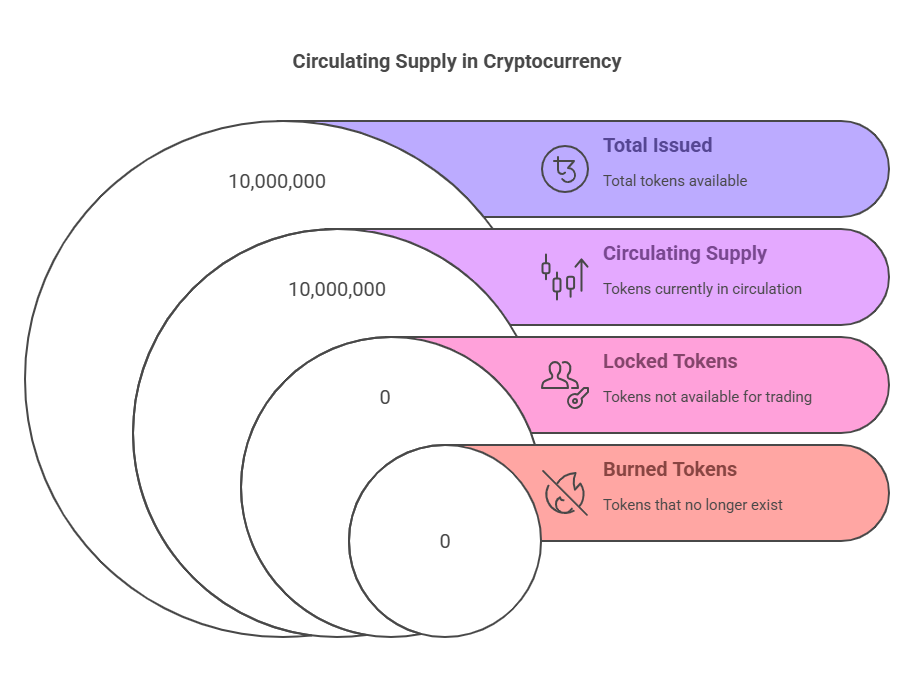
Tokens that are typically excluded from circulating supply include:
- Locked tokens – Coins held in vesting schedules for team members, founders, or early investors that cannot yet be traded.
- Staked tokens – Assets temporarily committed to securing a network or earning rewards, which may not be immediately liquid.
- Reserved tokens – Funds set aside for ecosystem development, partnerships, or project treasuries.
- Burned tokens – Coins permanently removed from circulation through token burn mechanisms.
Once these non-circulating tokens are accounted for, the remaining tokens represent the circulating supply.
This figure is important because it is commonly used to calculate market capitalization, one of the most widely referenced metrics in cryptocurrency markets.
Market capitalization is calculated using the following formula:
Market Cap = Circulating Supply × Current Price
For example, if a cryptocurrency has 10 million tokens in circulation and each token trades at $5, the market capitalization would be $50 million.
Because circulating supply can change over time through token unlocks, new issuance, staking releases, or token burns, it is a dynamic metric that can influence how a project’s market value is interpreted.
Circulating Supply vs Total Supply vs Max Supply
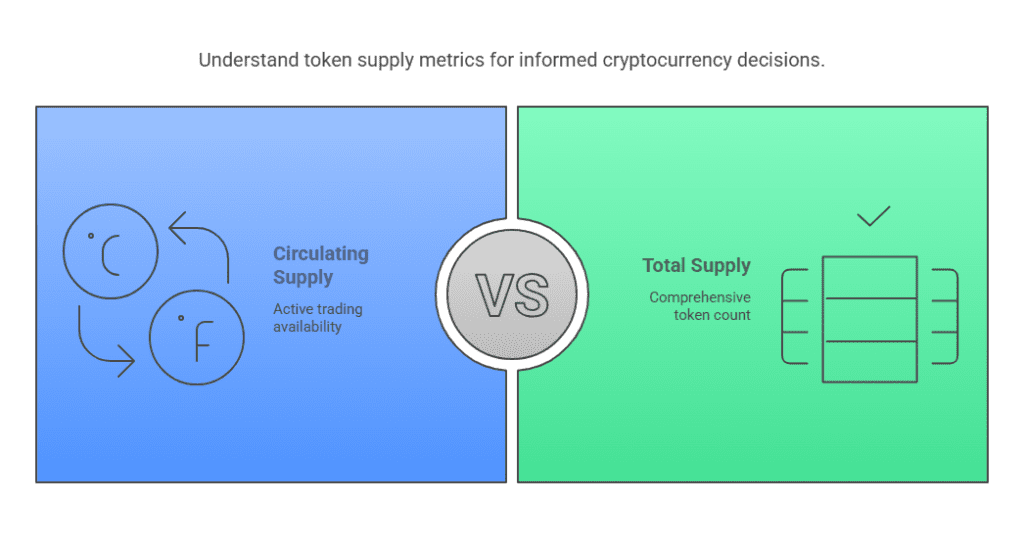
When evaluating a cryptocurrency, it is helpful to understand how circulating supply, total supply, and maximum supply differ. These three metrics describe different aspects of a project’s token distribution and future availability.
Circulating Supply
Circulating supply refers to the number of coins or tokens that are currently available for public trading in the market. It excludes tokens that are locked, reserved, or otherwise unavailable for use.
Because it represents the supply actively influencing price and liquidity, circulating supply is typically used when calculating market capitalization.
Total Supply
Total supply represents the number of tokens that currently exist, including both circulating tokens and those that are not yet available to the public.
This can include tokens that are:
- Locked in vesting contracts for team members or early investors
- Held in project reserves or development funds
- Temporarily inaccessible due to staking or other protocol mechanisms
Total supply does not include tokens that have been permanently destroyed through token burns.
Maximum Supply
Maximum supply is the upper limit on the number of tokens that will ever exist for a cryptocurrency. This limit is usually defined in the protocol’s code or monetary policy.
Some cryptocurrencies have a fixed maximum supply. For example, Bitcoin has a hard cap of 21 million coins.
Other cryptocurrencies may not have a fixed limit and can continue issuing new tokens according to their network rules.
Understanding the relationship between these three supply metrics helps provide a clearer picture of a cryptocurrency’s scarcity, issuance schedule, and potential long-term supply dynamics.
How Circulating Supply Affects Cryptocurrency Prices
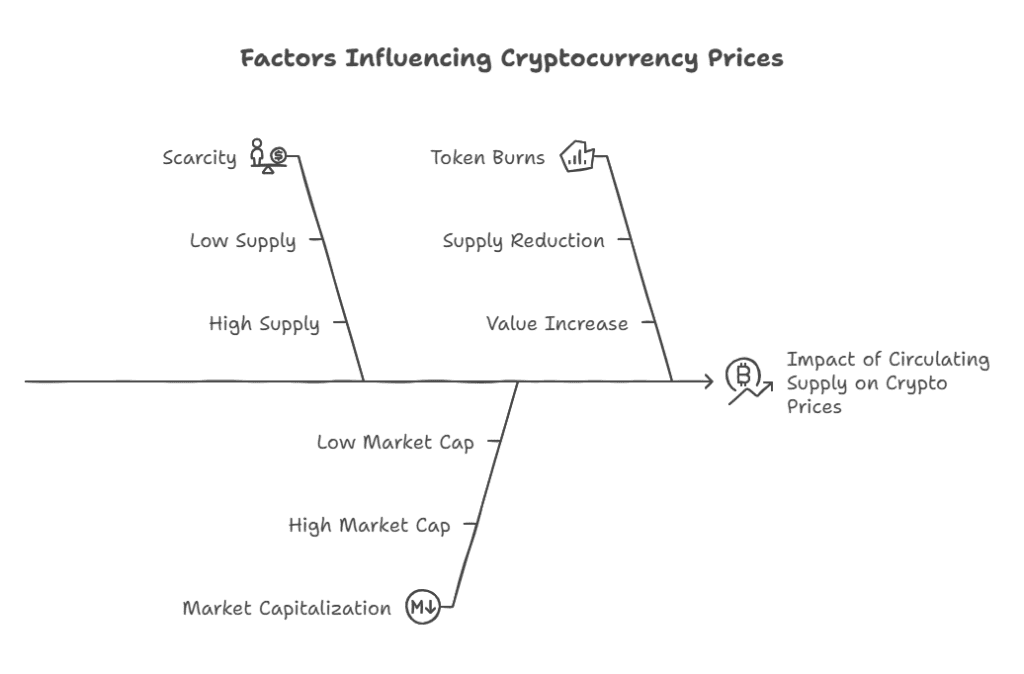
Circulating supply is one of the factors that helps determine how a cryptocurrency’s price is interpreted by the market. While supply alone does not determine price, it plays an important role in how scarcity, valuation, and market size are evaluated.
Relationship Between Supply and Market Capitalization
One of the main reasons circulating supply matters is because it is used to calculate market capitalization, a metric commonly used to compare the size of different cryptocurrencies.
Market capitalization is calculated as:
Market Cap = Circulating Supply × Current Price
A cryptocurrency with a higher circulating supply may require significantly more capital entering the market to increase its price compared to a coin with a smaller supply.
Perceived Scarcity
Supply can also influence how scarce an asset appears to market participants. Cryptocurrencies with limited supply caps may be perceived as more scarce, especially if demand grows over time.
For example, Bitcoin has a maximum supply of 21 million coins, which contributes to its reputation as a scarce digital asset.
However, scarcity alone does not determine value. Demand, utility, adoption, and broader market conditions also influence price behavior.
Changes in Circulating Supply
Circulating supply can change over time due to events such as:
- Token unlocks when previously locked tokens become tradable
- New token issuance through mining or staking rewards
- Token burns that permanently remove tokens from circulation
Announcements related to these events can sometimes affect market sentiment, since they may alter expectations about how much supply will be available in the future.
Understanding circulating supply helps provide context when evaluating cryptocurrency prices, but it should always be considered alongside other factors such as demand, technology, adoption, and market conditions.
What Happens When a Cryptocurrency Reaches Max Supply?
When a cryptocurrency reaches its maximum supply, it means the network will not create any additional coins beyond that limit. The total number of tokens that can ever exist has already been issued according to the project’s protocol.
For example, Bitcoin has a maximum supply of 21 million coins. Once that number is fully mined, no new Bitcoin will enter circulation through block rewards.
Reduced New Issuance
Before a cryptocurrency reaches its maximum supply, new coins are typically introduced through mechanisms such as mining or staking rewards. When the maximum supply is reached, this issuance stops.
At that point, participants who help maintain the network—such as miners or validators—may rely primarily on transaction fees rather than newly created tokens as compensation.
Impact on Supply Dynamics
Once the maximum supply is reached, the circulating supply may eventually stabilize if no additional tokens are issued. However, the effective supply available in the market can still change due to factors such as:
- Coins being lost because private keys are no longer accessible
- Tokens being permanently burned
- Assets remaining inactive in long-term storage
These factors can affect how much of the supply is actively circulating.
Market Considerations
Reaching maximum supply does not automatically guarantee price increases. Cryptocurrency prices continue to depend on multiple factors, including demand, adoption, market sentiment, and broader economic conditions.
However, supply limits are often considered by investors when evaluating the long-term monetary structure of a cryptocurrency.

Investment Strategies Based on Circulating Supply
Circulating supply can provide useful context when analyzing cryptocurrency markets, but it should be considered alongside other factors such as demand, utility, adoption, and token distribution. Some investors examine supply dynamics to better understand how a project’s token economics may influence market behavior.
High-Supply Cryptocurrencies
Some cryptocurrencies have very large circulating supplies, sometimes reaching billions or even trillions of tokens. Examples include Dogecoin and Shiba Inu.
Projects with large circulating supplies often have lower prices per token, although this does not necessarily reflect the overall value of the network. Market capitalization and demand are still the primary drivers of valuation.
Large supplies can contribute to higher liquidity in trading markets, but they may also require substantial demand growth for large price increases.
Lower-Supply Cryptocurrencies
Some cryptocurrencies have smaller circulating supplies, either due to design or controlled issuance schedules. For example, Bitcoin has a limited maximum supply, which contributes to its perception as a scarce digital asset.
Projects with lower supply levels may experience different market dynamics, but price performance still depends on many variables, including adoption, network activity, and broader market conditions.
Deflationary Supply Models
Certain projects implement mechanisms designed to reduce circulating supply over time. This may occur through token burns, where tokens are permanently removed from circulation.
For example, BNB periodically burns tokens according to its protocol rules. These mechanisms are often designed as part of a project’s broader tokenomics model.
Using Supply Metrics in Analysis
When evaluating cryptocurrencies, circulating supply is typically considered alongside other metrics such as:
- Market capitalization
- Token release schedules
- Network activity and usage
- Project governance and development
By reviewing these factors together, investors and analysts can develop a more complete understanding of a cryptocurrency’s market structure.
Conclusion
Circulating supply is one of the key metrics used to understand how cryptocurrencies are valued and compared in the market. By showing how many tokens are currently available for trading, it provides important context for evaluating price movements and calculating market capitalization.
When analyzed alongside total supply and maximum supply, circulating supply helps illustrate a project’s broader token distribution and long-term issuance structure. These factors can influence how market participants interpret scarcity, liquidity, and potential future supply changes.
For example, cryptocurrencies such as Bitcoin are often discussed in terms of their limited supply model, while other projects may have larger or continuously expanding token supplies.
While circulating supply alone does not determine the value of a cryptocurrency, understanding how it interacts with demand, market capitalization, and token release schedules can provide a clearer perspective when researching digital assets.
Taking time to review supply metrics alongside other indicators such as project fundamentals, network activity, and market conditions can help build a more complete understanding of how cryptocurrency markets function.

FAQs About Circulating Supply
What is circulating supply in cryptocurrency?
Circulating supply refers to the number of coins or tokens that are currently available for public trading in the market. It excludes assets that are locked, reserved, or otherwise unavailable for use.
How does circulating supply affect cryptocurrency price?
Circulating supply influences price primarily through its role in calculating market capitalization. A cryptocurrency with a larger supply may require more capital entering the market to significantly increase its price.
Which cryptocurrency has a low circulating supply?
Some cryptocurrencies are known for having relatively small supplies compared to others. For example, Bitcoin has a maximum supply of 21 million coins, while some projects issue billions or trillions of tokens.
Does burning tokens reduce circulating supply?
Yes. Token burns permanently remove tokens from circulation by sending them to addresses that cannot be accessed. This reduces the number of tokens available in the market.
Where can I find a cryptocurrency’s circulating supply?
Circulating supply data is typically available on cryptocurrency market data platforms such as CoinMarketCap and CoinGecko, which track supply metrics for many digital assets.
