A cold wallet is a cryptocurrency signing tool designed to keep private keys away from ordinary internet-connected environments.
This separation can reduce the opportunity for malware or remote attackers to obtain the keys directly. It does not make a wallet immune to theft, phishing, physical damage, fraudulent transactions, or setup mistakes.
Cold wallets also vary substantially. A hardware wallet that connects to a computer does not operate in the same way as an air-gapped signer. A metal recovery backup is not a wallet. A paper wallet introduces different risks from a modern hardware device.
This guide explains the main types of cold wallets, how offline transaction signing works, and what their security model does and does not protect.
Key Takeaways
- A cold wallet keeps private keys in an offline or isolated signing environment.
- A hardware wallet may connect to an online device while preventing its private keys from leaving the hardware signer.
- Cold storage is the broader security system. A cold wallet is one tool that may form part of that system.
- Recovery phrases can recreate wallet keys and require protection comparable to the signing device.
- Paper wallets are a legacy method with substantial key-generation, printing, and transaction-handling risks.
- Air-gapping reduces direct network exposure but does not prevent malicious files, compromised software, or human error.
- A cold wallet cannot stop a user from approving a fraudulent address, contract permission, or transaction.
- The quality of the complete key-management process matters more than the “cold” label.
Educational notice: This article provides general information about cryptocurrency wallet security. It does not provide investment, financial, legal, tax, or individualized cybersecurity advice. Wallet features and recovery procedures vary. Consult the official documentation for the wallet and blockchain network you use before handling private keys, recovery phrases, or transactions.
Affiliate disclosure: Some links on this website may be affiliate links. The publisher may receive compensation when a reader makes a purchase through one of those links. Commercial relationships do not determine the editorial conclusions presented in this guide.
What Is a Cold Wallet?
A cold wallet is a cryptocurrency wallet or signing device that keeps private keys in an environment isolated from normal internet-connected systems.
Private keys authorize transactions. The cryptocurrency itself remains represented on the blockchain rather than stored inside the physical wallet.
The wallet manages the information needed to:
- Derive blockchain addresses
- View account information
- Prepare transactions
- Authorize transactions with digital signatures
- Restore access through a supported recovery method
The Bitcoin Developer Guide describes offline and hardware wallets as signing-only wallets. An online system can prepare and broadcast transactions while the isolated wallet performs the signing operation.
This is more precise than saying every cold wallet remains permanently disconnected. Some hardware devices communicate with networked computers or phones while keeping their private keys inside the signing device.
Cold Wallet vs. Cold Storage
A cold wallet and cold storage are related but distinct concepts.
A cold wallet is a tool. It generates, stores, or uses private keys in an isolated environment.
Cold storage is the complete security arrangement. It may include:
- One or more cold wallets
- Recovery information
- Physical storage
- Access controls
- Software and firmware procedures
- Transaction-review procedures
- Inheritance or business-continuity planning
The distinction matters because a secure device can still be part of an insecure process.
For example, a hardware wallet offers limited protection if its recovery phrase is photographed and uploaded to cloud storage. A strong physical backup may also provide little protection if the owner approves a fraudulent transaction.
The NIST key-management framework treats key generation, storage, use, backup, recovery, and destruction as connected parts of the key lifecycle. Cold-wallet security should be evaluated in the same systemic way.

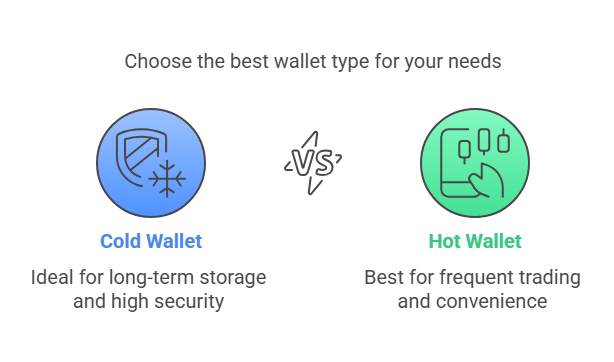
Cold Wallet vs. Hot Wallet
A hot wallet manages keys in an internet-connected environment. Examples can include mobile applications, browser extensions, desktop software, and some exchange accounts.
Cold and hot wallets create different operational trade-offs.
| Consideration | Cold Wallet | Hot Wallet |
| Key environment | Offline or isolated | Internet-connected |
| Transaction process | Usually requires a separate approval step | Usually faster and more direct |
| Remote key exposure | Reduced when implemented correctly | Generally greater |
| Physical responsibility | Usually higher with self-custody | Depends on the wallet or provider |
| Recovery responsibility | Usually rests with the user | Varies by service |
| Technical complexity | Can be moderate or high | Usually lower |
This comparison does not establish that every cold wallet is safer than every hot wallet.
A badly generated paper wallet may be less dependable than a properly maintained hot wallet. A cold wallet can also fail to protect funds when its recovery information is exposed or the user signs a harmful transaction.
How Cold Wallets Work
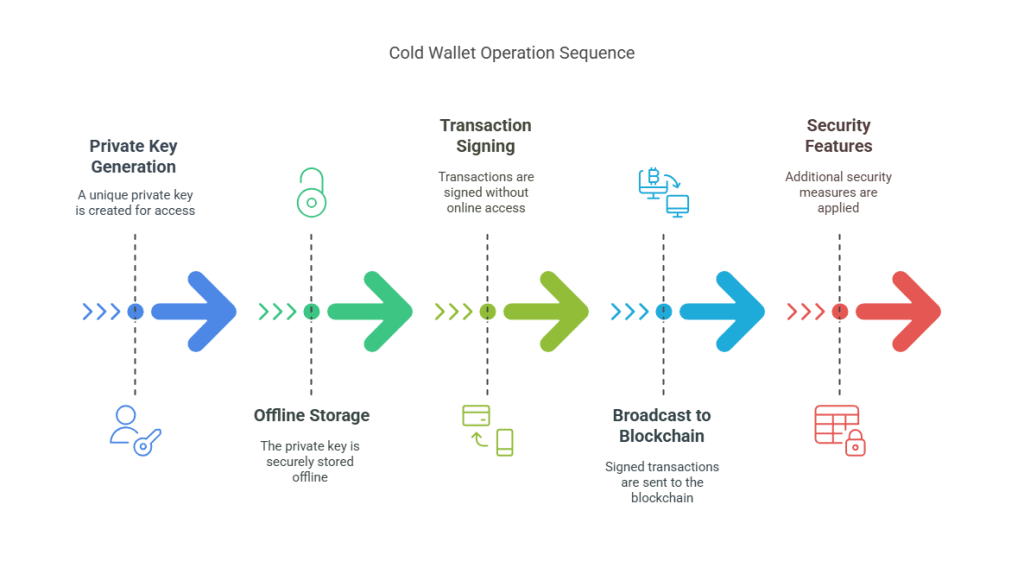
Most cold-wallet systems separate transaction preparation from transaction authorization.
Key Generation
The wallet creates cryptographic key material. Many wallets also generate a recovery phrase that can be used to reconstruct the wallet.
BIP 39 is one widely implemented standard for representing computer-generated entropy as a human-readable mnemonic phrase. The phrase is converted into a binary seed from which deterministic wallet keys can be derived. The official specification supports phrases of 12, 15, 18, 21, or 24 words. (BIP 39 specification)
A recovery phrase is not simply a login password. Depending on the wallet, it may recreate multiple private keys and accounts.
Ethereum.org’s security guidance describes the recovery phrase as the master key to a wallet and warns that anyone who obtains it may gain control of the associated accounts.
Transaction Preparation
An online application prepares an unsigned transaction.
The transaction may contain:
- A destination address
- An amount
- A network fee
- Token or asset information
- Smart-contract instructions
- Permission requests
The online application does not necessarily need the private key to perform this step.
Offline Signing
The unsigned transaction is transferred to the isolated wallet.
The signing device uses its private key to produce a valid digital signature. In a properly designed workflow, the private key remains inside the signing environment.
The Bitcoin Developer Guide describes a workflow in which an online wallet creates an unsigned transaction, an offline wallet reviews and signs it, and the online wallet broadcasts the signed transaction.
Broadcasting
The signed transaction returns to an internet-connected device and is submitted to the blockchain network.
The signed transaction can be public. The private key should remain secret.
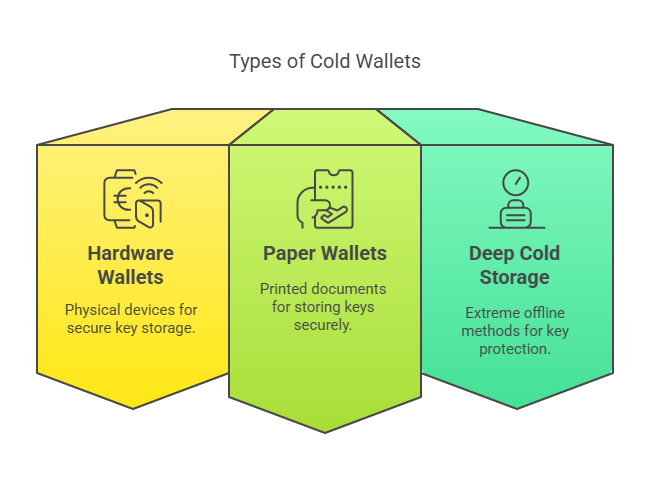
Types of Cold Wallets
Cold wallets can use different methods to isolate signing keys.
Hardware Wallets
A hardware wallet is a dedicated physical device designed to generate or use private keys.
It may connect to another device through:
- USB
- Bluetooth
- Near-field communication
- A memory card
- QR codes
The connection method does not determine security by itself. The more important questions are whether the keys remain isolated, whether transaction details can be independently reviewed, and whether the device and firmware operate as expected.
The Bitcoin Developer Guide describes hardware wallets as dedicated signing-only devices that can communicate with other systems without transferring private keys to them.
Hardware wallets can reduce reliance on a general-purpose computer. They still depend on:
- Authentic hardware
- Secure initialization
- Reliable firmware
- Accurate recovery information
- Careful transaction review
- Protection against theft or damage
Ethereum.org’s 2026 security report notes that hardware wallets retain their own attack surface and may be lost, damaged, stolen, or affected by supply-chain concerns. (Ethereum Trillion Dollar Security report)
Air-Gapped Signing Devices
An air-gapped wallet signs transactions without a direct network connection.
Data may move between the online and offline devices through:
- QR codes
- Memory cards
- Removable storage
- Other one-way or controlled transfer methods
Air-gapping can reduce direct network exposure. It does not guarantee that the device, software, transaction file, or transfer medium is trustworthy.
Potential risks include:
- Malicious transaction files
- Compromised wallet software
- Infected removable media
- Unsafe operating-system installation
- Incorrect transaction review
- Exposed recovery information
An air-gapped device should therefore be evaluated as part of a complete process rather than assumed secure because its network interfaces are disabled.
Offline Computers
A dedicated computer can act as a cold wallet when it generates keys or signs transactions without connecting to an online network.
This method provides flexibility but creates additional technical responsibilities.
The operator must consider:
- How the operating system was installed
- How wallet software was obtained and verified
- Whether network hardware is disabled
- How updates are handled
- How transaction data is transferred
- How malware is prevented
- How the machine and its backups are stored
The word offline describes connectivity. It does not prove that the system is free from malicious or vulnerable software.
Paper Wallets
A traditional paper wallet contains a cryptocurrency address and its corresponding private key, often printed as text and QR codes.
Paper removes ongoing internet connectivity, but it creates a difficult key-generation and spending process.
Possible risks include:
- Compromised wallet-generation software
- Insecure websites
- Printers that retain or transmit document data
- Temporary files left on the computer
- Photographs or scanned copies
- Fire, water, fading, or physical loss
- Incorrect key-import procedures
- Accidental exposure when spending
Paper wallets are better understood as a legacy key-storage method than as a simple beginner alternative to a hardware wallet.
A paper backup containing a recovery phrase is not the same thing as a traditional paper wallet containing an individual private key. The two formats may require different restoration procedures.
Multisignature Wallets
A multisignature wallet requires more than one key to authorize a transaction.
A two-of-three arrangement, for example, requires signatures from any two of three approved keys.
Multisignature arrangements can distribute authority across:
- Different devices
- Separate people
- Multiple physical locations
- An organization and a custody provider
The Bitcoin Wiki’s multisignature reference defines multisignature as requiring multiple keys to authorize a transaction instead of relying on one signing key.
Multisignature systems can reduce dependence on a single key. They can also increase complexity.
A failed setup, missing wallet configuration, incompatible software, poorly distributed keys, or an unclear recovery procedure may create new points of failure. Multisignature should therefore be treated as an access-control architecture, not as an automatic security upgrade.
Custodial Cold Wallets
Some companies store customer assets through offline or restricted signing systems.
This differs from self-custody.
In a custodial arrangement, the provider controls or participates in the process required to authorize transactions. The customer relies on the provider’s:
- Security controls
- Financial condition
- Legal obligations
- Withdrawal policies
- Recovery procedures
- Availability
Ethereum.org’s wallet guide distinguishes self-managed wallets from centralized exchange accounts, where the user relies on the exchange to maintain custody.
Cold storage describes how keys are isolated. It does not tell the reader who controls them.
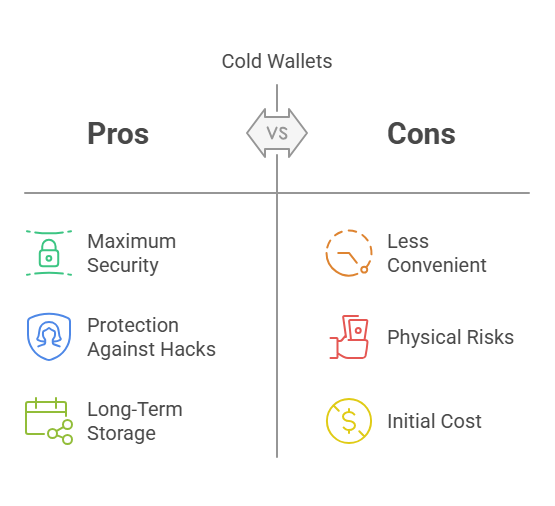
What Cold Wallets Can Protect Against
A properly implemented cold wallet can reduce several forms of exposure.
Malware That Searches for Private Keys
A private key that never enters the online computer is harder for malware on that computer to copy directly.
Remote Access to Wallet Files
An attacker who gains remote access to the online device may be unable to sign transactions without the separate cold wallet.
Compromised Online Wallet Interfaces
An online wallet can prepare or broadcast transactions without possessing the signing key.
However, the user must still verify transaction details on a trusted display. The Bitcoin Developer Guide specifically emphasizes reviewing the address and amount before an offline wallet signs the transaction. (Bitcoin Developer Guide)
Some Custodial Risks
Self-custody removes the need for an exchange or another service to control the user’s keys.
It also transfers responsibility for backup, access, transaction verification, and recovery to the user. This is a change in the trust model, not the removal of risk.
What Cold Wallets Do Not Protect Against
Cold wallets address private-key isolation. They do not solve every security problem.
Recovery-Phrase Exposure
A recovery phrase may recreate the wallet on another device.
Cold-wallet protection can therefore be bypassed when the phrase is:
- Entered into a fraudulent website
- Shared with false customer support
- Saved in cloud storage
- Stored as a screenshot
- Copied by another person
- Found with the physical wallet
Ethereum.org warns against sharing recovery phrases or saving screenshots because image files may synchronize to cloud services. (Ethereum security guidance)
Phishing
A cold wallet cannot prevent its owner from giving recovery information to an impersonator.
The Federal Trade Commission explains that phishing messages imitate trusted organizations to obtain passwords, account information, or other sensitive data.
No legitimate wallet-support interaction should require a user to send a recovery phrase through email, chat, a website, or a support form.
Fraudulent Transactions
A cold wallet can securely sign a harmful transaction.
The device may be protecting the key while the user approves:
- The wrong address
- An unexpected amount
- An unintended network
- A malicious contract interaction
- An excessive token allowance
- Unclear or unreadable signing data
Ethereum’s ERC-7730 proposal identifies clear transaction display on a hardware-wallet screen as an important security measure because users need understandable information before approving a transaction. (ERC-7730)
Physical Theft or Damage
A device or backup can be:
- Stolen
- Destroyed
- Misplaced
- Copied
- Damaged by water or fire
- Made inaccessible after the owner’s death or incapacity
Creating more backup copies may improve availability while increasing the number of locations that require protection.
Supply-Chain Problems
A cold wallet may be counterfeit, altered, preconfigured, or distributed with unsafe instructions.
Manufacturer documentation generally advises obtaining devices through official or authorized channels. For example, Trezor’s official purchasing guidance lists its shop and authorized resellers as recognized sources. This is product-specific commercial guidance, not independent evidence that any one manufacturer is universally safer.
Factors to Evaluate Before Using a Cold Wallet
No cold-wallet design is suitable for every technical or operational situation.
Useful evaluation questions include:
Which Networks and Assets Does It Support?
Support may vary by device, firmware, wallet application, token type, and network.
Compatibility should be confirmed through official documentation rather than assumed from a product name or advertisement.
Can Transaction Details Be Reviewed Clearly?
A trusted display should show enough information for the user to understand what is being authorized.
The ability to display an address does not guarantee that a complex smart-contract interaction will be explained clearly.
How Does Recovery Work?
Determine:
- What backup information the wallet creates
- Which standards it uses
- Which compatible wallets can restore it
- Whether an additional passphrase is involved
- What happens if the original manufacturer no longer operates
Ethereum.org notes that recovery options depend on the wallet type and that compatible wallet software may restore an account when the correct recovery phrase is available. (Ethereum community FAQ)
How Are Software and Firmware Verified?
The provider should publish clear procedures for obtaining and verifying updates.
Unexpected update requests, search advertisements, private messages, and unofficial download links increase impersonation risk.
Can the User Maintain the Process?
An architecture that is difficult to understand may be difficult to recover.
Additional devices, locations, passwords, passphrases, key shares, and participants can create resilience. They can also produce failure points when they are poorly documented or maintained.
Who Controls the Keys?
A wallet may be:
- Fully self-custodial
- Jointly controlled
- Multisignature
- Socially recoverable
- Custodial
- Dependent on a third-party service
The word wallet alone does not answer the custody question.

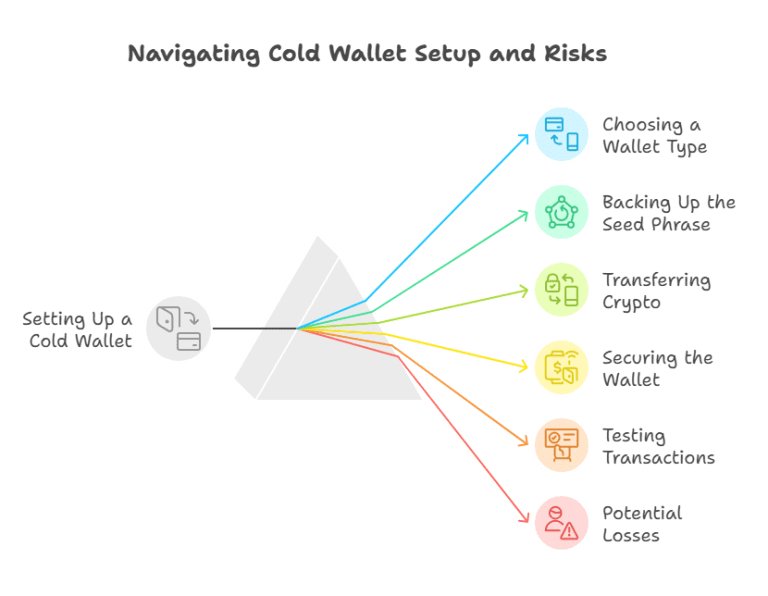
A General Cold-Wallet Setup Framework
The exact procedure must come from the wallet provider’s official documentation. The following framework explains the security questions involved without prescribing a specific product or transaction.
1. Verify the Source
Confirm that the device, software, and instructions came from recognized official channels.
Be cautious when packaging contains unexpected recovery words, PINs, or instructions. A legitimate wallet should generate new recovery information during setup rather than arrive with a phrase selected by someone else.
2. Initialize the Wallet in a Private Environment
Prevent cameras, visitors, screen-sharing tools, and other recording systems from viewing sensitive setup information.
3. Record Recovery Information Accurately
The phrase, word order, and any additional recovery settings must be recorded exactly as the wallet requires.
Do not invent recovery words. BIP 39 mnemonic phrases represent machine-generated entropy rather than a sentence chosen by the user. (BIP 39)
4. Protect the Recovery Method
Separate the recovery information from ordinary internet-connected storage.
Avoid placing it in:
- Cloud notes
- Screenshots
- Unencrypted files
- Messaging applications
- Online forms
5. Confirm the Receiving Address
Wallet software may display an address on the computer or phone. When supported, compare it with the address shown on the trusted signing device.
6. Review Transactions Before Signing
Confirm the available details on the signing device rather than relying solely on the online interface.
The wallet may not be able to explain every contract action. Unclear transaction data should not be treated as harmless merely because it reached a hardware device.
7. Maintain a Recovery Plan
The plan should address device failure, physical damage, forgotten procedures, software compatibility, and owner unavailability.
It should explain the system without unnecessarily placing every secret and instruction in one location.
Common Cold-Wallet Mistakes
Treating the Wallet Device as the Backup
A device may fail or become unavailable.
The recovery method, not the continued operation of the original hardware, often determines whether the wallet can be restored.
Photographing the Recovery Phrase
A photograph may be copied into cloud backups, shared albums, device migrations, or other synchronized services.
Entering Recovery Words Into a Website
A recovery phrase should not be entered into a website or sent to a support representative.
Wallet scams frequently imitate legitimate support channels and request recovery information. Ethereum.org and major hardware-wallet providers consistently warn that legitimate support personnel do not need the phrase.
Using a Prewritten Recovery Phrase
A phrase supplied inside the box or by another person may already be known to an attacker.
The wallet should generate new recovery information through its documented initialization process.
Signing Without Reading
An isolated key can still authorize an incorrect or malicious transaction.
The security benefit depends partly on the user understanding and verifying what the wallet is being asked to sign.
Assuming Air-Gapped Means Invulnerable
Air-gapping removes a direct connection. It does not validate the software, transaction, transfer medium, or operator.
Building a System That Cannot Be Recovered
Complexity can become a threat when the user cannot reconstruct the process later.
A recoverable and understood system may be more dependable than an elaborate arrangement that depends on undocumented steps.
When a Cold Wallet May Be Relevant
A cold wallet may be considered when the security requirements call for stronger separation between signing keys and ordinary networked devices.
Relevant operational factors include:
- How frequently transactions must be authorized
- Whether direct key control is required
- Whether physical backups can be protected
- Whether more than one person needs authorization authority
- Whether the user can review transaction details accurately
- Whether inheritance or organizational continuity must be addressed
- Whether the wallet will interact regularly with complex smart contracts
- Whether the user can follow the recovery procedure
These factors do not determine how much cryptocurrency someone should buy, hold, sell, or transfer. They describe security and access requirements only.
Conclusion
A cold wallet is an isolated transaction signer, not a complete guarantee against cryptocurrency loss.
Its main security benefit is reducing the direct exposure of private keys to internet-connected systems. That benefit depends on the integrity of the device, software, recovery process, physical storage, and transaction-review workflow.
Hardware wallets, air-gapped devices, offline computers, paper wallets, multisignature systems, and custodial cold wallets use different trust models. They should not be treated as interchangeable simply because they are described as cold.
The most important question is not whether a wallet is offline. It is whether the complete system protects key generation, storage, transaction signing, backup, recovery, and access over time.
Explore more cryptocurrency storage solutions in our Crypto Glossary.

Frequently Asked Questions
What Is a Cold Wallet?
A cold wallet is a cryptocurrency wallet or signing device that keeps private keys in an offline or isolated environment.
It may communicate with an internet-connected device as long as the private keys remain protected inside the signer.
Does a Cold Wallet Store Cryptocurrency?
No. The blockchain records the relevant account information and transactions. The wallet manages the keys used to authorize activity associated with those records.
Is a Hardware Wallet Always Offline?
Not necessarily. Many hardware wallets connect to a phone or computer when preparing or signing transactions. Their security model is based on isolating the private keys rather than preventing every form of communication.
Can a Cold Wallet Be Hacked?
No cold wallet should be treated as immune from attack.
Risk may arise through compromised hardware, malicious firmware, unsafe software, recovery-phrase theft, supply-chain interference, physical access, or fraudulent transaction approval.
Is a Paper Wallet a Cold Wallet?
A traditional paper wallet is commonly classified as a cold-storage method because its key is recorded offline.
However, generating, printing, importing, and spending from a paper wallet can create significant operational risks.
What Happens if a Cold Wallet Is Lost?
Recovery depends on the wallet design and available backup information.
A compatible recovery phrase or other supported backup may restore access. Without a valid recovery method, access may be permanently lost.
Is a Metal Recovery Backup a Cold Wallet?
No. A metal backup preserves recovery information. It does not normally generate keys, display addresses, or sign transactions.
Does a Cold Wallet Prevent Phishing?
No. It can isolate a private key, but it cannot stop someone from revealing a recovery phrase or approving a transaction requested through a fraudulent website.
Is Multisignature the Same as Cold Storage?
No. Multisignature is an authorization structure requiring multiple keys. Those keys may be stored in cold wallets, hot wallets, or a mixture of systems.
What Is the Safest Cold Wallet?
There is no universal answer.
Security depends on the wallet’s design, software, supply chain, recovery method, transaction display, custody model, physical protection, and the user’s ability to operate it correctly.
2 thoughts on “Cold Wallets for Crypto: How Offline Storage Works and When to Use It”