Introduction
A crypto wallet address is a public identifier used to specify a destination or account on a blockchain network.
It may look like a random string of letters and numbers, but its structure follows rules established by the network. Those rules differ across Bitcoin, Ethereum, XRP Ledger, Litecoin, Solana, and other blockchains.
A wallet address is not the wallet itself. It is also not automatically the same thing as a public key. Depending on the network, an address may represent a user-controlled account, a payment condition, a smart contract, or a program-controlled account.
Understanding these distinctions can help readers recognize wrong-network transfers, address-poisoning attacks, missing destination tags, and other common transaction risks.
Key Takeaways
- A crypto wallet address is a public identifier used to specify a blockchain account, payment destination, script, or program.
- A wallet may manage one address or many addresses, depending on the network and wallet design.
- An address is not always derived directly from a public key. Some addresses represent scripts, contracts, or program-derived accounts.
- Private keys authorize transactions. They should not be confused with the public addresses used to receive assets.
- Bitcoin and Ethereum process balances and transactions differently, so one transaction explanation does not apply to every blockchain.
- Address formats may identify a network or output type, but a visually valid address does not guarantee that the selected network or asset is correct.
- Copying, scanning a QR code, or checking only a few characters does not fully verify a destination.
- Public addresses do not normally provide spending authority, but they can expose transaction history and create privacy risks.
Educational notice: This article provides general information about blockchain addresses and wallet security. It does not provide investment, financial, legal, tax, or individualized cybersecurity advice. Address formats, recovery procedures, and transaction behavior vary by network and service. Confirm current requirements through the official documentation for the wallet, blockchain, or platform being used.
Affiliate disclosure: Some links on this website may be affiliate links. The publisher may receive compensation if a reader makes a purchase through one of those links. Affiliate relationships do not determine the editorial conclusions presented in this article.

What Is a Crypto Wallet Address?
A crypto wallet address is a network-specific identifier used to direct a transaction or identify an account.
The exact meaning of an address depends on the blockchain.
For example:
- A Bitcoin address generally represents a payment condition encoded in a standardized format.
- An Ethereum address identifies either an externally owned account or a contract account.
- An XRP Ledger address identifies an account and may be accompanied by a destination tag.
- A Solana address may be a public key or a program-derived address with no corresponding private key.
Bitcoin.org compares a Bitcoin address to an email or physical address because it is information a payer can use to direct a payment. It also recommends using new receiving addresses where possible to improve privacy. (Bitcoin.org: Address Definition)
The word address is therefore a convenient general term, not proof that every blockchain uses the same technical model.
Crypto Address vs. Crypto Wallet
A wallet and an address are not the same thing.
A wallet is software, hardware, or another system used to manage keys, accounts, addresses, transaction information, and signing operations.
An address is a public identifier used within a particular blockchain system.
One wallet may manage:
- Several receiving addresses
- Multiple blockchain accounts
- Different networks
- Token accounts
- Change addresses
- Contract accounts
- Watch-only addresses
The Bitcoin Developer Guide explains that wallet software creates or distributes public-key information, tracks relevant blockchain activity, and uses corresponding private keys to authorize spending. These functions can even be divided among separate wallet programs.
A wallet is the management system. An address is one piece of information managed or displayed by that system.
Crypto Address vs. Public Key
A public key and an address may be related, but they are not universally identical.
A public key is part of a cryptographic key pair. It allows others to verify signatures produced by the corresponding private key.
An address is normally a shorter or specially encoded identifier recognized by a blockchain or wallet application.
The relationship varies by network:
- Some addresses encode a hash of a public key.
- Some encode a hash of a script.
- Some are calculated from account-creation data.
- Some represent smart contracts.
- Some are derived for programs and have no corresponding private key.
For example, Bitcoin’s P2PKH addresses contain a public-key hash, while P2SH addresses contain a script hash. The Bitcoin glossary treats these as distinct destination types. (Bitcoin Developer Glossary)
On Solana, an account address can be an Ed25519 public key or a program-derived address. Solana’s documentation states that program-derived addresses do not have corresponding private keys. (Solana Program-Derived Addresses)
Crypto Address vs. Private Key
A private key is secret cryptographic information used to create digital signatures.
A public address is intended to be shared when receiving transactions or identifying an account.
The distinction is fundamental:
| Information | General Purpose | Should It Be Shared? |
| Wallet address | Identifies an account or transaction destination | Usually public |
| Public key | Verifies signatures or helps derive an address | Generally public when disclosed by the protocol |
| Private key | Creates authorization signatures | No |
| Recovery phrase | Reconstructs wallet key material in supported systems | No |
Possessing a private key may allow someone to produce valid signatures for the associated account or payment condition. It does not by itself prove legal ownership of the underlying assets.
How Crypto Addresses Are Created
There is no universal address-generation process.
The method depends on the blockchain and address type.
Key-Derived Addresses
Some addresses are derived from a public key or a hash of a public key.
A typical simplified sequence is:
- Wallet software generates a private key.
- A corresponding public key is calculated.
- The network’s address rules transform or encode that public key.
- A checksum or other validation information may be added.
- The wallet displays the resulting address.
This model applies to many user-controlled addresses, but not every blockchain destination.
Script-Based Addresses
Some Bitcoin address types represent a script or witness program rather than one individual public key.
A script can define conditions such as:
- One valid signature
- A threshold of several signatures
- A time-based restriction
- Another network-supported spending condition
The resulting address encodes a destination associated with those conditions.
Contract Addresses
Ethereum supports externally owned accounts and contract accounts.
Externally owned accounts are controlled through private keys. Contract accounts contain code and operate when transactions or messages call that code. (Ethereum.org: Accounts)
A contract address should not be assumed to have one corresponding private key.
Program-Derived Addresses
Some networks support addresses controlled by onchain programs rather than ordinary private keys.
Solana program-derived addresses are calculated from a program identifier and other inputs. The associated program can act for the address according to network rules, but there is no conventional private key for the address itself.
How Addresses Work in Transactions
Addresses help identify transaction participants or destinations, but transaction structure differs across blockchains.
Account-Based Transactions
Ethereum uses an account-based model.
An Ethereum transaction is a cryptographically signed instruction initiated by an account. A simple transaction may transfer ETH from one account to another, while another transaction may call a smart contract. (Ethereum.org: Transactions)
The network updates its account state after validating and processing the transaction.
This model is reasonably close to the familiar idea of one account sending value to another.
UTXO-Based Transactions
Bitcoin uses unspent transaction outputs, commonly called UTXOs.
A Bitcoin transaction:
- References one or more existing unspent outputs.
- Provides the data required to satisfy their spending conditions.
- Creates one or more new outputs.
- May create a separate change output for the sender.
The entire value of each referenced UTXO is consumed, with new outputs assigning value to new spending conditions. (Bitcoin Developer Guide: Transactions)
This means a Bitcoin transaction does not always have one simple sender address and one recipient address.
Wallet interfaces may simplify the presentation, but the underlying transaction can contain several inputs and outputs.
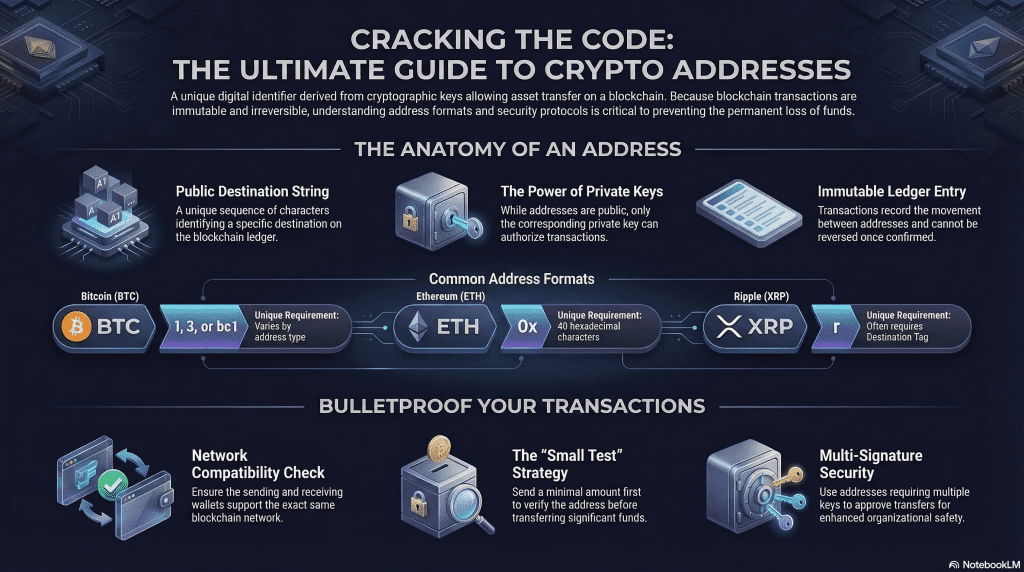
Common Crypto Address Formats
Address formats help wallets and networks interpret destinations correctly.
They do not guarantee that a transaction is appropriate or recoverable.
| Network | Common Format | Important Detail |
| Bitcoin | 1, 3, bc1q, or bc1p prefixes | Different prefixes represent different output and encoding formats. |
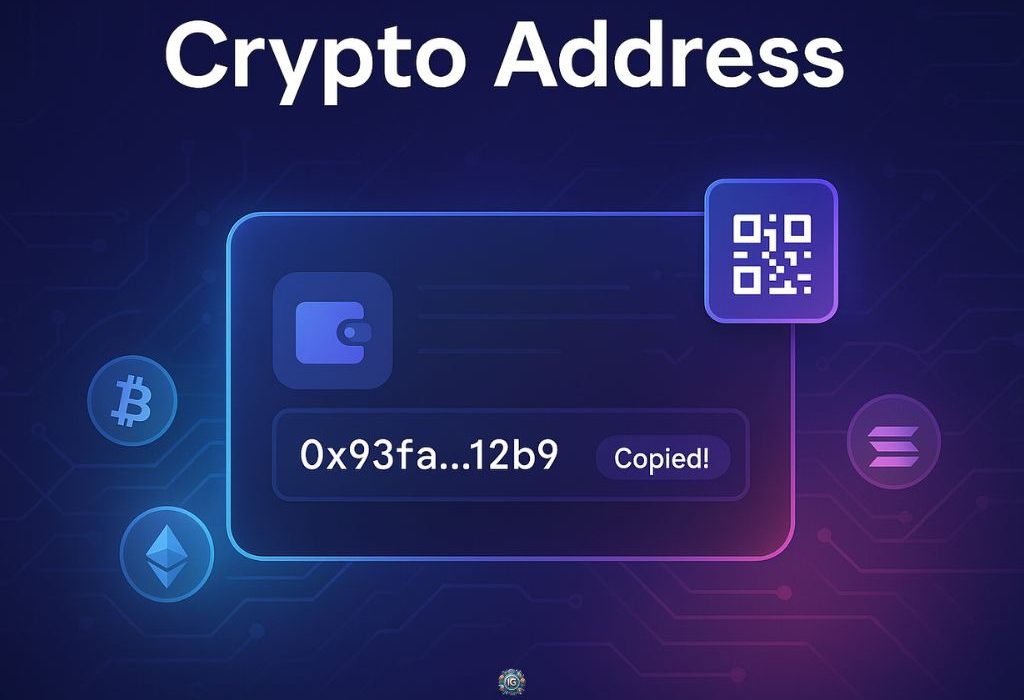
| Ethereum | 0x followed by 40 hexadecimal characters | The address may identify a user-controlled account or contract. |
| Litecoin | Common prefixes include L, M, and ltc1 | Similarity to Bitcoin formats does not make the networks interchangeable. |
| XRP Ledger | Classic addresses commonly begin with r | Some payments also require a destination tag. |
| Solana | Base58-encoded 32-byte value | The address may be a public key or program-derived address. |
Bitcoin Addresses
Common Bitcoin address forms include:
- Legacy P2PKH addresses beginning with 1
- P2SH addresses beginning with 3
- Native SegWit addresses commonly beginning with bc1q
- Taproot addresses commonly beginning with bc1p
BIP 173 defines Bech32 for native version 0 SegWit addresses. BIP 350 defines Bech32m for version 1 and later witness addresses, including Taproot.
An address beginning with bc1 should not automatically be described simply as “Bech32” without considering its witness version.
Ethereum Addresses
An Ethereum address is a 20-byte value typically displayed as 0x followed by 40 hexadecimal characters.
Ethereum uses the same basic address shape for externally owned accounts and contract accounts. (Ethereum.org: Accounts)
EIP-55 defines a mixed-case checksum convention that can help detect some mistyped addresses. A valid-looking Ethereum address still does not identify the selected blockchain network by itself.
Litecoin Addresses
Common Litecoin address prefixes include:
- L for certain legacy addresses
- M for certain script-hash addresses
- ltc1 for native SegWit formats
Litecoin uses network-specific prefixes to help distinguish its addresses from addresses used by other systems. (Litecoin Address and Prefix Documentation)
Visual similarity between Bitcoin and Litecoin addresses does not make them interchangeable.
XRP Ledger Addresses and Destination Tags
XRP Ledger classic addresses commonly begin with r.
A business or exchange may use one address for several customers and use destination tags to identify which internal account should receive credit.
XRP Ledger also supports an X-address presentation format that combines an account identifier and destination tag into one displayed value. (XRP Ledger Address Documentation)
A missing tag does not always mean the same thing. Some accounts reject payments without the required tag, while other services may receive the payment but be unable to credit it automatically. (XRP Ledger Destination Tags)
Solana Addresses
A Solana account address is a 32-byte value displayed using base58 encoding.
It may correspond to:
- A public key from a cryptographic key pair
- A program-derived address with no corresponding private key
This illustrates why “every address comes from a public and private key pair” is not a universal definition. (Solana Account Structure)
Why One Wallet May Have Several Addresses
A wallet may manage multiple addresses for several reasons.
Privacy
Repeatedly using one public address can make transaction activity easier to connect.
Bitcoin documentation recommends using new receiving addresses to reduce linkability between payments. (Bitcoin.org: Protect Your Privacy)
Change Outputs
A Bitcoin wallet may send unused value from a transaction input to a new change output controlled by the same wallet.
The user may therefore control several addresses even when the wallet interface presents one combined balance.
Account Organization
Some wallets allow users to create different accounts or addresses for separate purposes.
Network Differences
A multi-network wallet may display different addresses for Bitcoin, Ethereum, Solana, XRP Ledger, and other networks.
Even when two networks display the same address string, the records and assets on those networks remain separate.

Common Crypto Address Risks
Wrong-Network Transfers
A destination can appear valid while the selected network is wrong.
This is particularly relevant on networks that use similar or identical address formats. An Ethereum-style address does not, by itself, identify which compatible chain the sender intended to use.
Recovery may depend on:
- Who controls the destination keys
- Whether the receiving wallet supports the network
- Whether a custodian can assist
- Whether the asset or contract exists on that network
- The platform’s recovery policies
Address Poisoning
Address poisoning attempts to place a similar-looking attacker-controlled address into a wallet’s transaction history.
The attacker hopes the user will later copy that address instead of the intended destination.
MetaMask’s address-poisoning guidance warns that attackers may imitate visible sections of a familiar address. Checking only the first and last few characters may therefore be inadequate.
Clipboard Replacement
Malware may monitor copied text and replace a cryptocurrency address with another destination.
Copying an address reduces manual typing, but it does not prove that the pasted value remained unchanged. (MetaMask: Clipboard Hacking)
Missing Destination Tags or Memos
Some custodians and blockchain systems use additional identifiers to assign one receiving address to several customers.
The wallet address and tag or memo must be treated as separate transaction fields unless the supported format combines them.
Contract Address Confusion
A token contract address identifies the token’s smart contract. It is not necessarily a destination to which the token should be transferred.
Sending an asset directly to a contract that is not designed to receive or recover it may make the asset inaccessible.
Unsupported Assets
An address can be technically valid while the receiving wallet or custodian does not support the asset.
In a self-custodial wallet, the asset may still be associated with an address controlled by the user but remain hidden from the current interface. In a custodial system, recovery depends on the provider’s infrastructure and policies.
QR-Code Substitution
A QR code encodes data. It does not independently verify that the data is correct.
A fraudulent invoice, altered website, or compromised screen can present a QR code containing an attacker’s address.
Address Reuse and Privacy
Public blockchain activity is generally visible.
Bitcoin.org notes that balances and transactions associated with known addresses can be inspected publicly. Ethereum describes public addresses as pseudonymous rather than fully anonymous.
Sharing an address does not normally provide spending authority, but it may reveal transaction history and financial relationships.
How to Verify a Crypto Address
No single check eliminates every form of address risk.
A stronger verification process considers several independent details.
Confirm the Network
Verify that the sending wallet, receiving wallet, asset, and destination all use the intended blockchain network.
Do not rely only on the address shape. Several networks use similar formats.
Obtain the Address From a Trusted Source
Use the recipient’s verified wallet, account dashboard, invoice, or another established communication channel.
Transaction history should not automatically be treated as a trusted address book because address-poisoning attacks deliberately target that behavior.
Compare the Address on a Trusted Display
When a hardware wallet or separate signing device displays the destination, compare that display with the intended recipient information.
Checking only a few characters may not identify a deliberately similar address.
Confirm Tags and Memos
Where a platform provides a destination tag, memo, or payment identifier, confirm whether it is required and whether it belongs to the intended account.
Review the Asset and Destination Type
Confirm whether the displayed value is:
- A wallet address
- An exchange deposit address
- A token contract
- A smart contract
- A program address
- A payment request
- A recipient name resolved to an address
These identifiers are not interchangeable.
Treat a Test Transaction as an Additional Check
Some users and wallet providers describe sending a nominal transaction before a separate transfer.
This can confirm that a particular destination was reachable under the tested conditions. It does not protect against later address replacement, a changed network, a changed tag, or a different destination.
It may also create additional network fees and should not replace full transaction review.
Common Misconceptions
“The Address Stores the Cryptocurrency”
The blockchain or distributed ledger records the relevant state, outputs, balances, or ownership conditions.
The displayed address is an identifier used to interpret or locate part of that state.
“Every Address Has One Private Key”
Some user-controlled addresses correspond to a private key, but script addresses, smart contracts, multisignature arrangements, and program-derived addresses can use different authorization structures.
“A Wallet Has Only One Address”
Many wallets derive or manage numerous addresses and accounts.
“A Valid Address Means the Network Is Correct”
An address can pass format validation while the chosen network, asset, contract, tag, or recipient remains wrong.
“Similar Addresses Are Probably the Same”
Cryptocurrency addresses must match according to the network’s exact rules. Visual similarity does not establish identity.
“A Public Address Is Completely Anonymous”
An address normally does not contain a person’s name, but public transaction history can be analyzed and linked with information from exchanges, websites, payments, or public disclosures.
Conclusion
A crypto wallet address is a public identifier used to specify a blockchain destination, account, script, contract, or program.
The term does not have one identical technical meaning across every network. Bitcoin addresses can represent public-key hashes, scripts, or witness programs. Ethereum addresses identify externally owned or contract accounts. XRP Ledger payments may require destination tags. Solana supports addresses that have no corresponding private key.
This variation is why address safety involves more than copying a string correctly.
The network, asset, destination type, tag or memo, contract interaction, and displayed transaction details must all agree. The address is one part of the transaction, not proof that every other part is correct.
Frequently Asked Questions
Is a Crypto Address the Same as a Wallet?
No. A wallet manages keys, accounts, addresses, transaction data, and signing functions. An address is a public identifier used within a blockchain system.
Is It Safe to Share a Crypto Address?
A receiving address is generally intended to be shared.
Sharing it does not normally provide the private key needed to authorize transactions. However, it may allow others to inspect associated activity on a public blockchain.
Can Someone Steal Cryptocurrency With Only an Address?
An address alone does not normally provide signing authority.
An attacker can still use a public address for surveillance, phishing, address poisoning, impersonation, or other targeted attacks.
Is a Crypto Address the Same as a Public Key?
Not always. Some addresses are derived from public keys. Others represent scripts, contracts, witness programs, or program-derived accounts.
Can One Wallet Have Multiple Addresses?
Yes. A wallet may derive several receiving addresses, change addresses, accounts, and network-specific destinations.
Do Cryptocurrency Addresses Expire?
Blockchain addresses generally do not expire automatically.
A service or exchange may stop displaying, supporting, or crediting an older deposit address. Current deposit instructions should be confirmed with that provider.
Can the Same Address Appear on Different Networks?
Yes. Ethereum-compatible networks can use the same address format, and a wallet may control the same apparent address on several networks. Activity and balances on those networks remain separate.
What Happens if Cryptocurrency Is Sent to the Wrong Address?
Most blockchain protocols do not provide a built-in chargeback mechanism.
Possible recovery depends on who controls the destination, the network involved, the wallet architecture, and whether a service provider can assist.
What Is Address Poisoning?
Address poisoning is an attack in which an attacker creates or uses an address resembling a familiar destination and attempts to place it in the user’s transaction history.
The objective is to cause the user to copy the attacker’s address during a later transaction.
Why Did an Exchange Change My Deposit Address?
A platform may rotate deposit addresses for technical, security, accounting, or network-related reasons.
An older address may remain functional, but that should not be assumed. The provider’s current deposit instructions are the relevant source.
1 thought on “Cryptocurrency Addresses: What They Are & How They Work”