Introduction
Many cryptocurrency platforms offer ways to earn rewards on digital assets through activities such as staking, lending, or providing liquidity. These rewards are often expressed using APY, a metric that reflects how returns may accumulate over time when earnings are reinvested.
Because compounding can significantly influence long-term results, investors often want to estimate how their holdings might grow under different conditions. Small changes in yield rates, compounding frequency, or investment duration can lead to very different outcomes over time.
Planning tools designed for yield calculations help translate these variables into clear projections. By adjusting inputs such as deposit amount, APY rate, and time horizon, users can explore how different scenarios may affect the potential growth of their crypto holdings.
This guide explains how APY works in cryptocurrency contexts, how compounding affects returns, and how yield calculators can be used to estimate possible outcomes based on different assumptions.
Key Takeaways
- APY (Annual Percentage Yield) measures the potential return on crypto assets when rewards are compounded over time.
- A crypto APY calculator estimates how holdings may grow based on deposit amount, yield rate, compounding frequency, and investment duration.
- Compounding means rewards can generate additional rewards when they are reinvested.
- Calculators help visualize long-term scenarios and compare different yield opportunities.
- Results are projections based on assumptions and do not guarantee future returns.
Disclaimer: Some links on this website are affiliate links. That means if you click and make a purchase, we may earn a small commission at no extra cost to you. The views expressed here are not official statements from any outside company.

Crypto APY Calculator
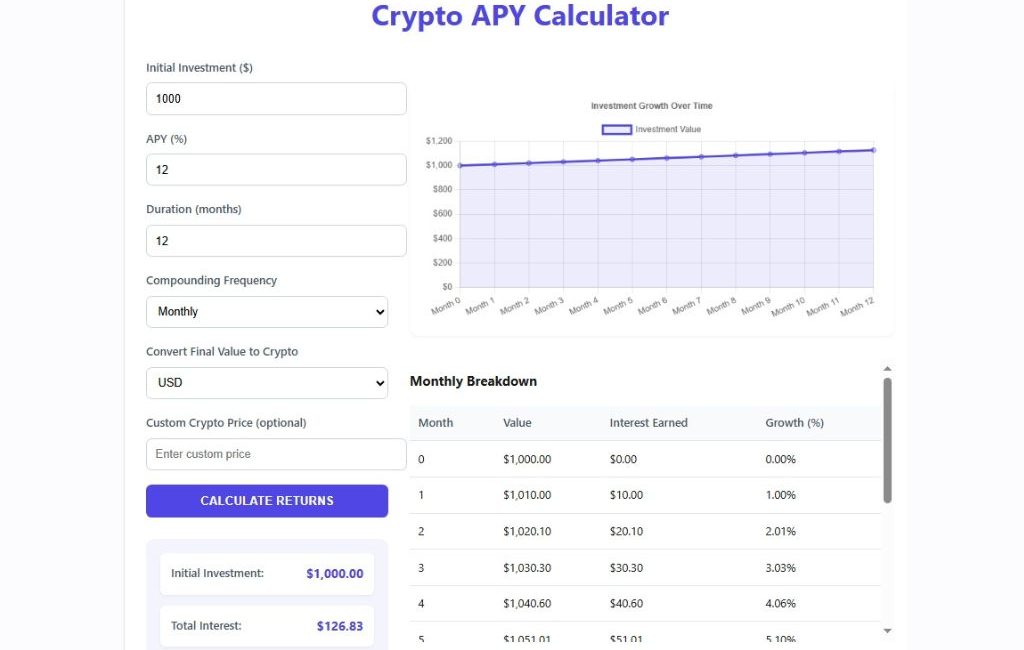
Use our calculator to estimate how your cryptocurrency holdings might grow when returns are compounded over time.
Most crypto APY calculators use the following inputs:
- Initial Deposit – the amount of cryptocurrency or value you plan to invest
- APY Rate – the annual percentage yield offered by the platform
- Compounding Frequency – how often rewards are reinvested (daily, weekly, monthly, etc.)
- Investment Duration – the length of time you plan to keep the funds invested
After entering these values, the calculator estimates the projected balance based on compound growth. The result typically includes the final balance, the total rewards earned, and the difference between the original deposit and the projected value.
Because the calculation is based on the values provided, the output represents a projection rather than a guaranteed return. Adjusting the inputs allows users to compare different scenarios and understand how yield rates and compounding frequency may influence long-term growth.
What Is APY in Crypto?
APY (Annual Percentage Yield) represents the annual return on an investment when the effects of compounding are included. In cryptocurrency, APY is commonly used to describe the potential yield earned from activities such as staking, lending, or providing liquidity.
The key characteristic of APY is that it accounts for compound growth. This means that rewards earned during the investment period can be reinvested and begin generating additional rewards.
For example, if a platform offers a 10% APY, the estimate assumes that any rewards earned are added back to the original balance and continue to earn yield throughout the year. Over time, this compounding effect can increase the total return compared with simple interest.
APY is often used in cryptocurrency platforms that offer yield opportunities, including:
- Staking – locking cryptocurrency to support a blockchain network and receive rewards
- Yield farming – providing liquidity to decentralized finance (DeFi) protocols in exchange for incentives
- Crypto savings or lending platforms – depositing assets to earn interest
Because APY includes compounding, it provides a clearer estimate of how an investment might grow over time compared with metrics that measure only simple interest.
What Does a Crypto APY Calculator Do?
A crypto APY calculator estimates how digital assets might grow over time when returns are compounded. By entering a few key inputs, the tool calculates the projected balance based on an assumed yield rate and investment duration.
Most calculators use the following variables:
- Initial deposit – the starting amount of cryptocurrency or value invested
- APY rate – the annual percentage yield offered by a platform or protocol
- Compounding frequency – how often rewards are added back to the balance
- Investment period – the length of time the assets remain invested
Using these inputs, the calculator applies a compound interest formula to estimate the potential future value of the investment.
This allows users to explore different scenarios. For example, someone may want to compare how a 6% APY compounded daily differs from an 8% APY compounded monthly, or how extending an investment from three years to five years affects projected growth.
While the results depend entirely on the values entered, the calculator helps illustrate how yield rates and compounding frequency may influence long-term outcomes.
How APY Compounding Works
Crypto APY calculations are based on the principle of compound growth, where earned rewards are periodically added back to the original balance and begin generating additional rewards.
The standard formula used for compounding calculations is:
A = P × (1 + r / n)^(n × t)
Where:
- A = the final amount after compounding
- P = the initial investment (principal)
- r = the annual interest rate expressed as a decimal
- n = the number of compounding periods per year
- t = the total time the investment remains active, measured in years
This formula estimates how the balance grows as rewards are reinvested over time.
For example, if an investment compounds monthly, rewards are added to the balance twelve times per year. If it compounds daily, the balance increases more frequently, which can slightly increase the overall return.
Because compounding builds on previous rewards, longer investment periods generally produce larger differences between simple interest and compound growth. Small variations in yield rates or compounding frequency can therefore have a noticeable impact over extended timeframes.
Example of APY Growth
To see how APY affects crypto holdings over time, consider a simple scenario where rewards are continuously reinvested.
Assume an investor deposits $1,000 worth of cryptocurrency into a platform offering 8% APY, with rewards compounded monthly. If the investment remains unchanged for three years, the compounding process gradually increases the balance each time rewards are added.
Using the compound growth formula, the projected balance would develop approximately as follows:
Initial Deposit: $1,000
APY: 8%
Compounding: Monthly
After one year, the balance would grow to roughly $1,083.
If the investment continues without withdrawals, compounding continues to build on previous rewards. By the end of the third year, the balance would reach approximately $1,270.
This example illustrates how compounding gradually increases returns over time. Each reinvested reward becomes part of the balance that generates the next round of earnings.
By adjusting the deposit amount, yield rate, compounding frequency, or investment duration in the calculator, users can explore how different assumptions may influence the projected growth of their crypto holdings.

Risks and Limitations
Crypto APY calculators can help illustrate how compounding may affect potential returns, but it is important to understand the limitations of these projections. The results shown by the calculator are based on assumptions and simplified models, which means real-world outcomes may differ.
Variable Yield Rates
In many cryptocurrency platforms, APY rates are not fixed. Staking rewards, lending yields, or DeFi incentives may change depending on network conditions, liquidity levels, or platform policies. If the yield rate changes, the actual return may differ from the projected result.
Price Volatility
The calculator measures growth in the amount of cryptocurrency or its current value, but it does not account for market price changes. Because cryptocurrency prices can fluctuate significantly, the value of the earned rewards may rise or fall over time.
Platform and Protocol Risk
Some yield opportunities rely on decentralized finance protocols or centralized platforms. Security vulnerabilities, smart contract issues, or operational failures may affect the safety of funds. These risks are not reflected in calculator projections.
Fees and Costs
Transaction fees, platform fees, and network costs may reduce actual earnings. Many calculators estimate growth using gross yield rates and may not include these additional costs.
Simplified Growth Assumptions
Most calculators assume consistent compounding and uninterrupted reinvestment of rewards. In practice, users may withdraw earnings, adjust positions, or experience changes in yield conditions that affect the final outcome.
Understanding these limitations helps ensure that APY calculators are used as planning tools rather than precise forecasts of future returns.
Conclusion
Understanding how compounding affects investment growth is an important part of evaluating yield opportunities in cryptocurrency. Because rewards can accumulate and generate additional rewards over time, even small differences in yield rates or investment duration may influence long-term outcomes.
A crypto APY calculator helps translate these variables into measurable projections. By adjusting factors such as deposit amount, yield rate, compounding frequency, and time horizon, users can explore different scenarios and better understand how compounding may affect their holdings.
Although these projections are based on assumptions and simplified calculations, they can provide useful context when comparing yield opportunities or planning long-term strategies. Used thoughtfully, APY calculators offer a practical way to visualize how compounding may shape the growth of crypto assets over time.

Frequently Asked Questions
What is APY in cryptocurrency?
APY (Annual Percentage Yield) represents the estimated annual return on an investment when compounding is included. In cryptocurrency, APY is commonly used to describe potential rewards from activities such as staking, lending, or providing liquidity.
How is APY different from APR?
APR (Annual Percentage Rate) reflects simple interest without compounding. APY includes the effect of reinvesting earnings over time, which can lead to a higher effective return when rewards are compounded.
Are crypto APY calculators accurate?
Crypto APY calculators are mathematically accurate based on the values entered. However, the results are projections. Actual returns may vary depending on changing yield rates, market conditions, fees, and other factors.
Can I use an APY calculator for any cryptocurrency?
Yes. As long as the investment involves a yield rate expressed as APY or APR, the calculator can estimate potential growth. The tool is not limited to a specific cryptocurrency.
Do APY calculators include platform fees or gas costs?
Most calculators estimate growth using the yield rate provided and may not automatically include platform fees, network transaction costs, or other charges. These costs may need to be considered separately when evaluating actual returns.
1 thought on “Crypto APY Calculator: Estimate Compound Yield on Your Crypto”