Introduction
Two common approaches appear in long-term investing: systematic investing and one-time investing. These are often referred to as Systematic Investment Plans (SIPs) and lumpsum investments.
Both methods aim to grow capital over time, but they differ in how and when money enters the market. A SIP spreads investments across regular intervals, while a lumpsum investment places the entire amount into the market at once.
Because of this difference, each approach behaves differently during market fluctuations and fits different financial situations. Factors such as income patterns, risk tolerance, time horizon, and investment discipline can influence which method feels more appropriate.
This guide explains how SIP and lumpsum investing work, how they respond to market conditions, and what types of investors typically prefer each approach. The goal is not to declare a universal winner, but to help clarify which strategy may align better with your financial plan.
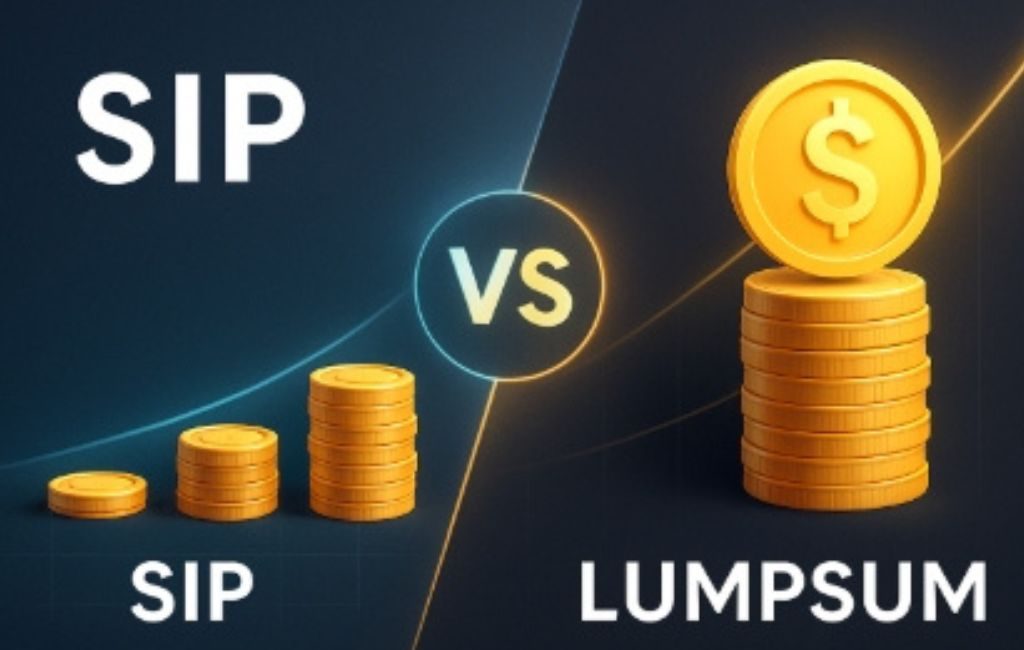
What Is SIP Investing?
A Systematic Investment Plan (SIP) is an investment approach where a fixed amount of money is invested at regular intervals. These intervals are usually monthly, although some platforms allow weekly or quarterly contributions.
Instead of investing a large amount at once, the investment is spread over time. Each contribution purchases units of the selected investment based on the market price at that moment.
Because the purchase price changes over time, this approach naturally results in buying more units when prices are lower and fewer units when prices are higher. Over a long period, this process can reduce the impact of short-term market fluctuations on the overall entry price.
SIPs are commonly used in mutual funds and other long-term investment vehicles. They are often chosen by investors who receive regular income and prefer to invest gradually rather than committing a large amount of capital at a single point in time.
Another practical advantage of SIP investing is that it introduces structure. Once contributions are scheduled, the investment process can continue automatically, helping investors maintain consistency over long investment horizons.
What Is Lumpsum Investing?
Lumpsum investing refers to investing a larger amount of money into an investment at a single point in time rather than spreading the investment across multiple installments.
Once the funds are invested, the entire amount is exposed to market movements from that moment forward. The performance of the investment therefore depends largely on how the market behaves after the investment is made.
Lumpsum investing often occurs when an investor receives a significant amount of capital at once. Common situations include bonuses, inheritance, business proceeds, or funds released from another investment.
Because the full capital is invested immediately, any market gains or losses affect the entire amount. If markets rise after the investment, the full amount participates in that growth. If markets decline shortly after investing, the entire investment reflects that decline as well.
For this reason, lumpsum investing is often associated with investors who have available capital ready to deploy and who are comfortable with full market exposure from the beginning of the investment period.
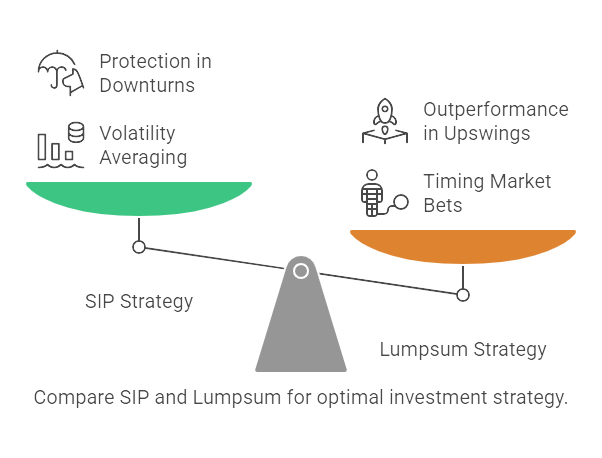
SIP vs Lumpsum: Core Differences at a Glance
The main difference between SIP and lumpsum investing lies in how and when capital enters the market. While both strategies aim to build wealth over time, they follow different paths to reach that goal.
| Factor | SIP | Lumpsum |
|---|---|---|
| Capital Deployment | Invested gradually over time | Invested all at once |
| Market Timing Exposure | Lower because investments are spread out | Higher because entry happens at one moment |
| Cash Flow Fit | Works well with recurring income | Works well with surplus or one-time capital |
| Flexibility | Contributions can often be adjusted or paused | Adjustments typically require selling or reallocating investments |
| Volatility Impact | Market fluctuations affect smaller installments | Market movements affect the entire investment immediately |
| Decision Structure | Regular, scheduled investing | One-time allocation decision |
In simple terms, SIP focuses on consistency over time, while lumpsum investing focuses on immediate market exposure.
Neither approach removes market risk entirely. Instead, they distribute that risk differently. Understanding this structural difference helps explain why each strategy behaves differently during market changes and why different investors may prefer one approach over the other.
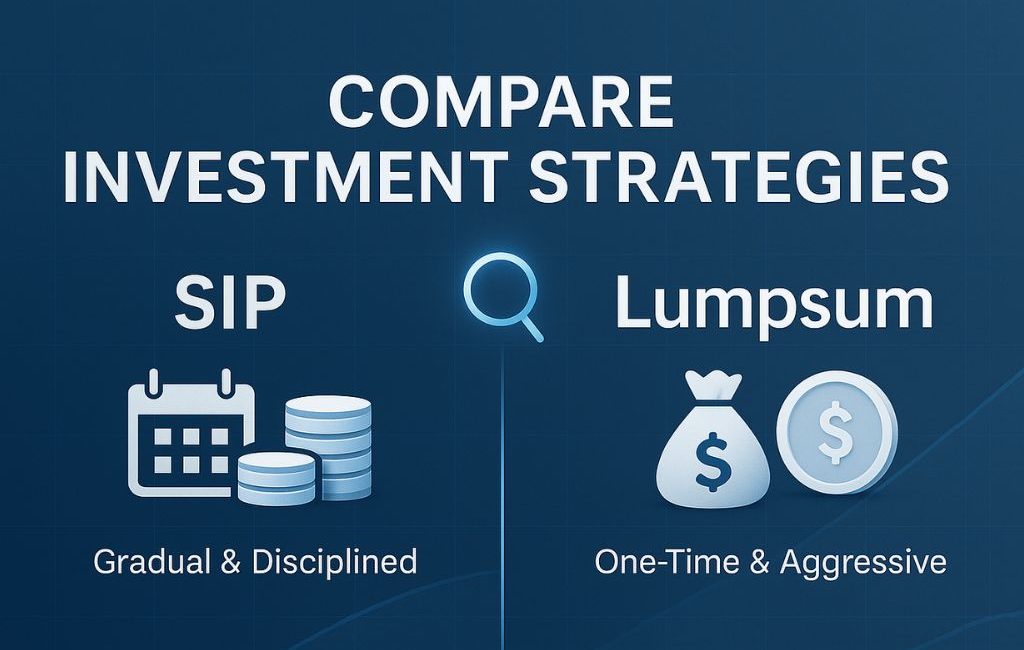
Market Timing and Volatility
Market behavior can influence how each strategy performs, particularly in the short term. The key difference lies in how much of your capital is exposed to the market at any given moment.
SIP and Market Volatility
With SIP investing, capital enters the market gradually. Because investments are spread across many time periods, the purchase price varies over time.
This structure means that:
- some installments may be invested when prices are higher
- others may be invested when prices are lower
Over a long investment horizon, these different entry points can reduce the impact of a single poorly timed investment.
SIPs therefore distribute market timing risk across multiple periods rather than concentrating it at one moment.
Lumpsum and Market Timing
In a lumpsum investment, the entire capital is invested at once. As a result, the investment outcome is more sensitive to the market level at the time of entry.
If markets rise after the investment, the full amount participates in that growth from the beginning. If markets decline shortly after investing, the entire amount experiences that decline immediately.
Because of this, lumpsum investing places greater importance on the timing of the initial investment.
Key Consideration
Neither approach eliminates market risk. Instead, they handle timing exposure differently:
- SIP spreads entry across time
- Lumpsum concentrates entry at one moment
For long-term investors, the choice often depends on how comfortable they are with immediate market exposure versus gradual entry into the market.
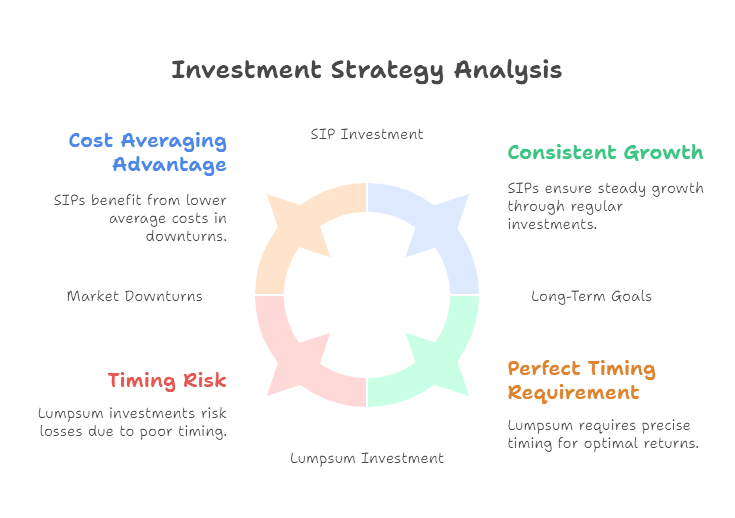
Cash Flow and Liquidity Considerations
Another important factor when choosing between SIP and lumpsum investing is how money flows into your finances. The way you earn, save, and allocate funds often determines which approach feels more practical.
SIP and Recurring Income
SIP investing fits naturally with recurring income streams. When income arrives regularly, such as through a monthly salary or consistent business revenue, smaller periodic investments can be easier to maintain.
This approach allows investors to:
- allocate a fixed portion of income toward investments
- continue investing without needing a large upfront amount
- maintain a structured investment routine over time
Because contributions are spread out, SIPs can help investors participate in markets while keeping enough liquidity for everyday expenses and financial obligations.
Lumpsum and One-Time Capital
Lumpsum investing is more common when a larger amount of capital becomes available at once. This can occur after events such as receiving a bonus, selling an asset, or moving funds from another investment.
In these situations, investors may prefer to deploy the available capital in a single investment rather than dividing it across multiple installments.
However, before committing a lumpsum investment, many investors consider whether they want to keep a portion of funds available for emergencies or near-term financial needs.
Practical Perspective
The choice between SIP and lumpsum investing often reflects financial circumstances rather than purely strategic preference.
- Investors with steady income may find SIPs easier to maintain.
- Investors with surplus capital available immediately may consider lumpsum investing.
Understanding how your cash flow and liquidity needs interact with each approach can make it easier to choose a strategy that fits your financial situation.

SIP vs Lumpsum: Risk and Downside Exposure
All investments involve risk, but SIP and lumpsum strategies distribute that risk in different ways. The key difference is how much capital is exposed to the market at one time.
SIP and Gradual Exposure
With SIP investing, only a portion of the total planned investment enters the market at each interval. This means that during a market decline, only the installments already invested are affected.
At the same time, future installments continue to be invested at the new market prices. When prices are lower, the same fixed investment amount purchases more units of the investment.
Because of this gradual exposure, SIP investing spreads risk across multiple entry points rather than concentrating it at one moment.
Lumpsum and Immediate Exposure
Lumpsum investing exposes the entire capital to the market from the beginning. Any market movement after the investment directly affects the full amount.
If the market rises after the investment, the entire capital participates in that growth immediately. If the market declines shortly after investing, the entire investment reflects that decline.
For this reason, lumpsum investing can feel more sensitive to short-term market fluctuations, especially during volatile periods.
Key Consideration
The difference is not that one strategy removes risk while the other creates it. Instead, the two strategies allocate market exposure differently.
- SIP distributes risk across time
- Lumpsum concentrates exposure at the initial investment point
For long-term investors, the appropriate approach often depends on their comfort with short-term fluctuations and how they prefer to manage market entry.
Return Potential and Trade-Offs
A common question in this comparison is which strategy produces higher returns. The outcome, however, depends largely on market behavior and the timing of investments.
Lumpsum Return Characteristics
When a lumpsum investment is made before a sustained market rise, the entire capital benefits from that growth immediately. Because all funds are invested from the start, compounding applies to the full amount from day one.
In these situations, lumpsum investing can produce higher returns compared with gradually investing the same amount over time.
However, the outcome changes if the investment is made before a market decline or during a period of high volatility. In that case, the portfolio may experience an immediate drop in value before recovery occurs.
SIP Return Characteristics
With SIP investing, the capital enters the market gradually. Because investments occur at different price levels over time, the average purchase cost reflects multiple market conditions.
This structure does not guarantee higher returns, but it reduces the impact of entering the market at a single unfavorable point.
SIPs often perform well in environments where markets move sideways or experience repeated fluctuations over long periods.
Understanding the Trade-Off
The difference between the two strategies can be summarized as a trade-off between timing sensitivity and gradual entry.
- Lumpsum investing benefits when the market rises soon after the investment.
- SIP investing reduces the impact of a single entry point by distributing investments across time.
Over long investment horizons, both strategies can support portfolio growth. The more relevant consideration is often how comfortable an investor is with the timing exposure associated with each approach.

SIP vs Lumpsum: Psychological Fit and Investor Behavior
Investment strategies are not only about numbers and market conditions. The ability to remain consistent during market fluctuations also plays an important role in long-term investing.
SIP and Consistency
SIP investing introduces a structured routine. Because contributions are scheduled in advance, the decision to invest does not need to be repeated every time money enters the market.
This structure can make it easier for some investors to remain consistent, especially during periods of market volatility. Instead of reacting to short-term market movements, the investment process continues according to the predetermined schedule.
For investors who prefer a systematic approach, this routine may reduce the pressure of deciding when to invest.
Lumpsum and Decision Pressure
Lumpsum investing involves committing a larger amount of capital at a single point in time. Because the full investment is made at once, the decision about when to invest can feel more significant.
After the investment is made, market movements may affect the entire portfolio immediately. For some investors, this may require greater comfort with short-term fluctuations and the ability to remain focused on long-term objectives.
Behavioral Considerations
Different investors respond differently to market movements. Some prefer the structure and predictability of regular investing, while others are comfortable allocating capital at a single point in time.
Understanding how you typically react to market changes can help determine which approach feels easier to maintain over the long term.
Flexibility and Ability to Adjust the Strategy
Investment strategies often need to adapt as financial circumstances change. Income levels, expenses, and financial priorities can shift over time, so the ability to adjust an investment approach can be an important consideration.
SIP Flexibility
SIPs are generally designed to be adjustable. In many cases, investors can:
- increase or decrease the periodic investment amount
- pause contributions temporarily
- resume investing later
- stop new installments without redeeming the existing investment
Because SIP contributions occur over time, these adjustments usually affect future installments rather than the capital that has already been invested.
This structure can make SIP investing easier to adapt to changing financial conditions.
Lumpsum Adjustments
Lumpsum investing is less flexible after the initial investment is made. Once the funds are deployed, the capital remains invested unless the investor decides to sell or rebalance the position.
Adjusting a lumpsum investment typically involves:
- redeeming part of the investment
- reallocating funds to other assets
- making an additional lumpsum investment later
These actions may involve timing considerations or potential tax implications depending on the type of investment.
Practical Consideration
The difference between the two approaches is not that one is flexible and the other is not. Instead, they differ in when adjustments can be made.
- SIP adjustments usually affect future contributions
- Lumpsum adjustments usually require changes to an existing investment
Understanding how easily you may need to modify your investment plan can help determine which structure feels more manageable over time.
Using a Hybrid Approach: Combining SIP and Lumpsum
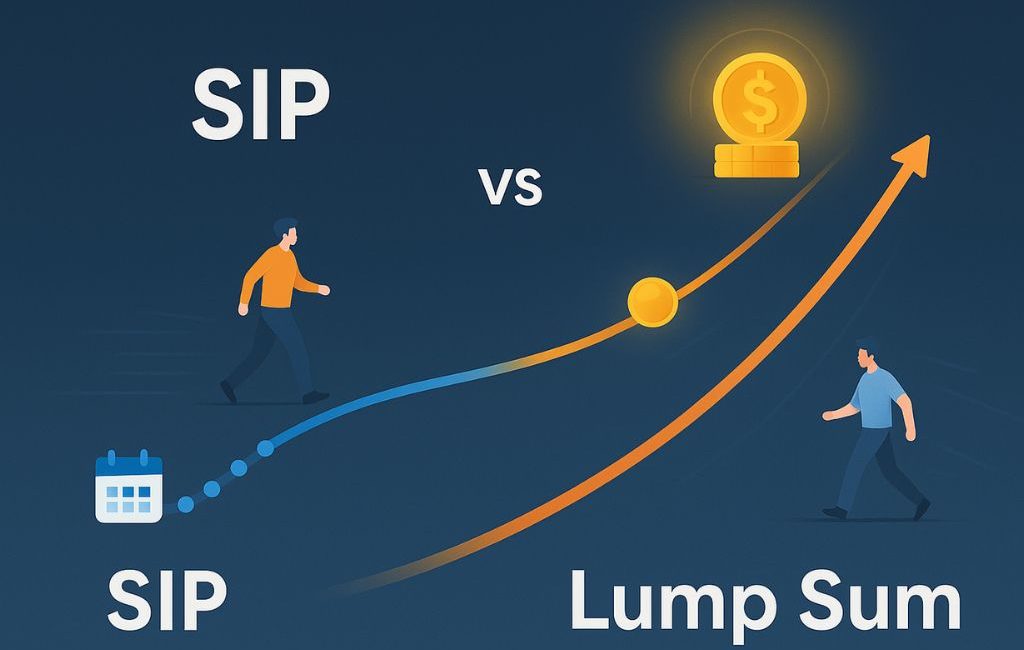
In practice, many investors do not rely exclusively on one method. Instead, they combine SIP and lumpsum investing depending on when capital becomes available and how they want to manage market exposure.
How a Hybrid Approach Works
A hybrid approach typically involves investing a portion of available capital immediately while continuing to invest regularly over time.
For example, an investor who receives a large amount of capital may choose to invest part of it as a lumpsum and allocate the remainder through periodic SIP contributions. This allows the portfolio to gain immediate market exposure while still maintaining gradual investment over time.
Situations Where Hybrid Investing May Be Used
A combination approach can appear in several common situations:
- An investor receives a bonus and invests part of it immediately while committing to monthly investments afterward.
- Capital from an asset sale is partially invested at once, with the remaining funds scheduled for regular contributions.
- An investor maintains ongoing SIP contributions while occasionally adding lumpsum investments when additional funds become available.
Practical Perspective
Using both methods can allow investors to balance immediate market participation with gradual capital deployment. The approach can also help align investing with real-world cash flow, where income arrives periodically but larger amounts of capital may appear at specific moments.
Rather than viewing SIP and lumpsum investing as mutually exclusive strategies, many investors treat them as complementary tools within a broader investment plan.
Common Misconceptions About SIP and Lumpsum Investing
Discussions about SIP and lumpsum investing often include simplified claims that do not reflect how these strategies work in real investment situations. Clarifying these misconceptions can help investors evaluate each approach more realistically.
“Lumpsum investing always produces higher returns”
This outcome depends heavily on when the investment is made. If a lumpsum investment is placed before a sustained market rise, it may produce higher returns because the entire capital participates in the growth from the beginning.
However, if the investment occurs before a market decline or during a volatile period, the results may differ. Market conditions and timing influence outcomes in both strategies.
“SIP investing is only for small investors”
SIP is a method of investing rather than a measure of portfolio size. Investors with different levels of capital may use SIPs to spread market entry over time or to maintain regular contributions to their portfolios.
The strategy can be used regardless of whether the investment amount is relatively small or large.
“You must choose one strategy permanently”
Investment strategies can evolve as financial situations change. Some investors begin with one approach and later incorporate the other depending on income patterns, available capital, or investment opportunities.
Because of this flexibility, SIP and lumpsum investing are not mutually exclusive methods.
“One strategy is always safer”
Both approaches involve market risk. SIP spreads investments across time, while lumpsum investing commits the full capital at once. Each method distributes risk differently rather than eliminating it.
Understanding these differences can help investors choose the approach that aligns with their financial circumstances and comfort with market fluctuations.
SIP vs Lumpsum: Side-by-Side Comparison
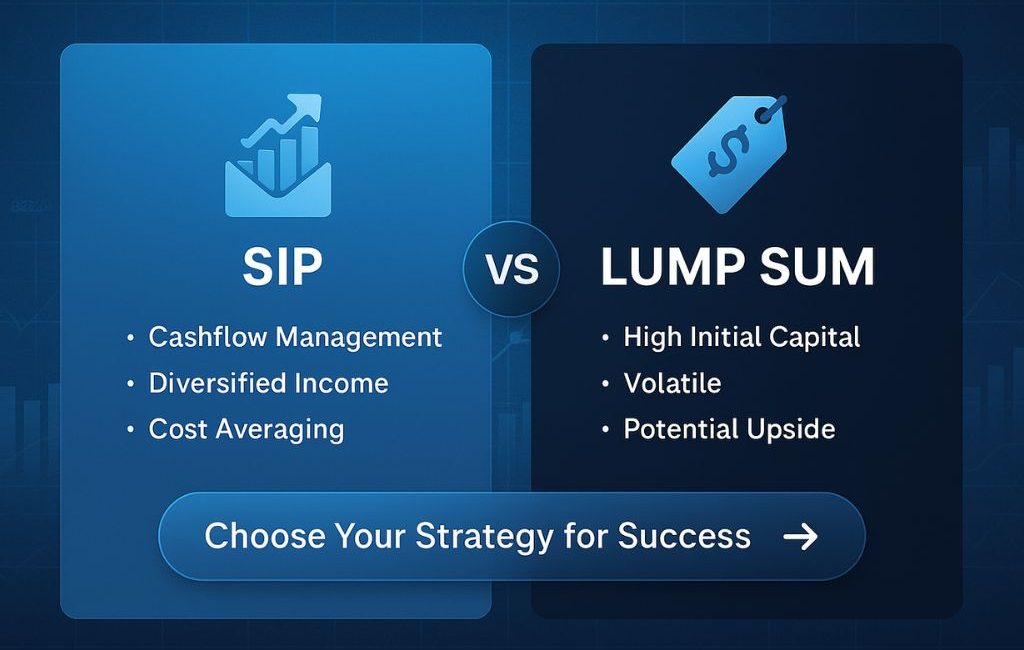
The following table summarizes the key differences between SIP and lumpsum investing. The goal is not to identify a universally better strategy, but to highlight how each approach behaves under different financial and market conditions.
| Factor | SIP (Systematic Investment Plan) | Lumpsum Investment |
|---|---|---|
| Capital Deployment | Invested gradually at regular intervals | Invested in a single transaction |
| Market Timing Exposure | Lower, because entry is spread across multiple periods | Higher, because the entire investment depends on one entry point |
| Cash Flow Fit | Suitable for investors with recurring income | Suitable when a larger amount of capital is available at once |
| Volatility Impact | Market fluctuations affect smaller installments over time | Market movements affect the entire investment immediately |
| Flexibility | Contributions can usually be adjusted, paused, or stopped | Adjustments often require selling or reallocating investments |
| Return Pattern | May produce smoother entry across market cycles | May produce higher returns if invested before sustained market growth |
| Behavioral Considerations | Encourages consistency through scheduled investing | Requires confidence in committing capital at one moment |
| Typical Use Case | Long-term investing through periodic contributions | Deploying windfalls, bonuses, or surplus capital |
This comparison highlights that the difference between SIP and lumpsum investing is primarily structural. Each approach distributes market exposure differently, which influences risk experience, timing sensitivity, and how the strategy fits within an investor’s financial situation.
Conclusion
SIP and lumpsum investing represent two different ways of entering the market, each with its own advantages and trade-offs.
SIP investing focuses on gradual participation. By spreading investments over regular intervals, it distributes market entry across time and can align well with recurring income and long-term investment routines.
Lumpsum investing places the entire capital into the market at once. This approach provides immediate exposure to market movements and may be appropriate when a larger amount of capital becomes available.
Neither strategy is universally better. The more suitable choice often depends on factors such as cash flow, time horizon, tolerance for market fluctuations, and personal investment habits.
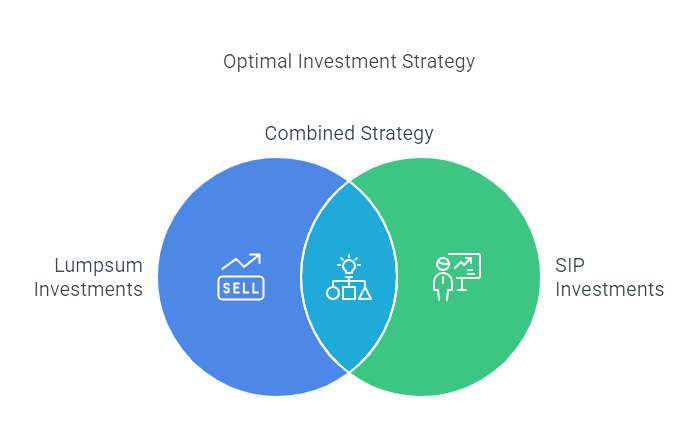
For many investors, the decision is not strictly one or the other. A combination of both approaches can allow immediate investment of available capital while maintaining consistent contributions over time.
Ultimately, the strategy that aligns best with your financial situation and that you can maintain consistently over the long term is often the most practical choice.
Frequently Asked Questions
Which strategy usually produces higher returns: SIP or lumpsum?
The result depends largely on market conditions. If markets rise soon after a lumpsum investment, the entire capital benefits from that growth from the beginning. With SIP investing, capital enters gradually, which spreads entry points across time. Over long periods, both strategies can support portfolio growth, but the outcomes may differ depending on market timing.
Is SIP less risky than lumpsum investing?
Both strategies involve market risk. SIP reduces timing exposure by spreading investments across multiple periods, while lumpsum investing commits the full capital at once. The difference lies in how the market exposure is distributed rather than whether risk exists.
Can an investor use both SIP and lumpsum investing?
Yes. Some investors combine the two approaches. For example, a larger amount of capital may be invested initially, while regular contributions continue through a SIP structure. This can allow for both immediate market exposure and ongoing investment discipline.
What happens if a SIP contribution stops?
If SIP contributions stop, the installments already invested remain in the portfolio and continue to reflect market performance. Stopping future installments does not cancel or reverse the existing investment.
Do SIP and lumpsum investments have different tax rules?
Tax treatment generally depends on the type of investment rather than the method used. However, with SIP investing, each installment may have its own holding period, while a lumpsum investment typically shares a single investment date for the entire amount.
1 thought on “SIP vs Lumpsum: Which Strategy Aligns with Your Financial Plan?”
Comments are closed.